
|
You entered: NASA
 APOD: 2025 February 26 Б Einstein Ring Surrounds Nearby Galaxy Center
26.02.2025
Do you see the ring? If you look very closely at the center of the featured galaxy NGC 6505, a ring becomes evident. It is the gravity of NGC 6505, the nearby (z = 0.042)...
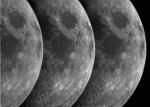 Cassini Images The Moon
10.09.1999
On August 18, the Cassini spacecraft flew by the Earth and Moon, then continued on its way to the outer solar system. Near its closest approach to the Moon, a distance of about 377,000 kilometers, controllers tested Cassini's imaging systems on this most familiar celestial body.
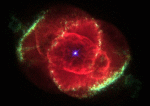 The Cat's Eye Nebula (Revisited)
4.07.1996
Three thousand light years away, a dying star throws off shells of glowing gas. This image from the Hubble Space Telescope reveals "The Cat's Eye Nebula" to be one of the most complex planetary nebulae known.
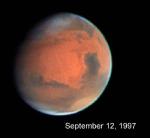 A Martian Autumn Begins
23.09.1997
Today is the first day of Autumn in the Northern Hemisphere of Planet Earth. The Autumnal Equinox occured yesterday at 7:56 pm EDT as the Sun crossed the celestial equator from North to South.
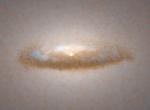 The Doomed Dust Disk of NGC 7052
22.06.1998
What created the dust disk in the center of NGC 7052, and what keeps it spinning? Although the disk might appear as a relatively tame "hubcap in space", the unusual center of elliptical galaxy NGC 7052 is probably the remnant of a titanic collision between galaxies.
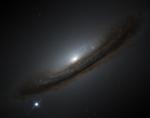 Supernova 1994D and the Unexpected Universe
30.12.1998
Far away, long ago, a star exploded. Supernova 1994D, visible as the bright spot on the lower left, occurred in the outskirts of disk galaxy NGC 4526. Supernova 1994D was not of interest for how different it was, but rather for how similar it was to other supernovae.
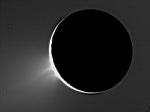 Ice Fountains Discovered on Saturns Enceladus
5.12.2005
Fountains of ice shoot out from Saturn's moon Enceladus. Clear discovery images of the fountains were made using observations from the robot Cassini spacecraft currently orbiting Saturn. During a recent pass, Cassini was programmed to look back toward the Sun where Enceladus would appear as a thin crescent.
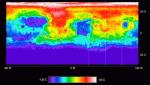 Thermal Mars
2.06.1999
It's 2 AM on Mars and surface temperatures range from -65C to -120C, as measured by the Thermal Emission Spectrometer (TES) onboard the Mars Global Surveyor spacecraft. TES data used...
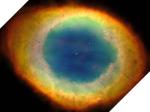 M57: The Ring Nebula
25.06.2006
It looked like a ring on the sky. Hundreds of years ago astronomers noticed a nebula with a most unusual shape. Now known as M57 or NGC 6720, the gas cloud became popularly known as the Ring Nebula.
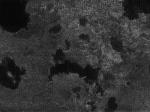 Possible Methane Lakes on Titan
31.07.2006
Have methane lakes been discovered on Saturn's Titan? That exciting possibility was uncovered from analyses of radar images returned last week by the robotic Cassini spacecraft now orbiting Saturn. The above image is a radar reflection from terrain near Titan's North Pole and spans a region about 200 kilometers across.
|
January February March April May June July August September October |
|||||||||||||||||||||||||||||||||||||||||||||||||