
|
You entered: NASA
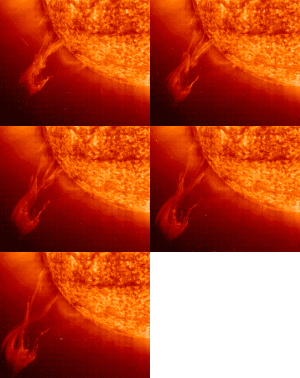 A Twisted Solar Eruptive Prominence
3.04.2000
A huge eruptive prominence is seen moving out from our Sun in this condensed half-hour time-lapse sequence. Ten Earths could easily fit in the "claw" of this seemingly solar monster. This large prominence, though, is significant not only for its size, but its shape.
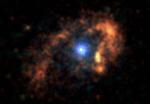 Eta Carinae in X Rays
11.10.1999
Eta Carinae is the one of the most luminous star systems in our Galaxy, radiating millions of times more power than our Sun. Eta Carinae is also one of the strangest star systems known, brightening and fading greatly since the early 1800s.
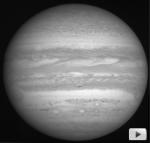 Watch Jupiter Rotate
12.03.2007
What would it be like to coast by Jupiter and watch it rotate? This was just the experience of the New Horizons spacecraft as it approached and flew by Jupiter earlier this year. Clicking on the image will bring up a movie of what the robotic spacecraft saw.
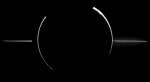 Jupiters Rings Revealed
6.01.2008
Why does Jupiter have rings? Jupiter's rings were discovered in 1979 by the passing Voyager 1 spacecraft, but their origin was a mystery. Data from the Galileo spacecraft that orbited Jupiter from 1995 to 2003 later confirmed that these rings were created by meteoroid impacts on small nearby moons.
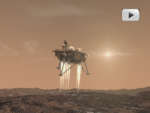 Phoenix Lander Arrives at Mars
25.05.2008
Will Phoenix survive its landing today on Mars? Phoenix's landing sequence will ramp up starting at about 7:30 pm EDT (23:30 UTC) today and last just over an hour. If all goes well, one of Phoenix's first images from Mars will appear on APOD tomorrow.
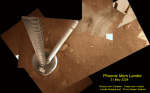 Phoenix and the Snow Queen
12.06.2008
A flat, smooth, shiny feature dubbed the Snow Queen is near the top of this color mosaic of the surface beneath the Phoenix Mars Lander. Recorded with the lander's robotic arm camera as it was maneuvered to look under the lander, the region also includes a leg and plate-sized footpad.
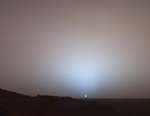 Martian Sunset
10.01.2009
This month, the Mars Exploration Rovers are celebrating their 5th anniversary of operations on the surface of the Red Planet. The serene sunset view, part of their extensive legacy of images from the martian surface, was recorded by the Spirit rover on May 19, 2005.
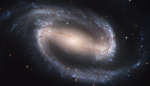 Barred Spiral Galaxy NGC 1300
25.03.2012
Big, beautiful, barred spiral galaxy NGC 1300 lies some 70 million light-years away on the banks of the constellation Eridanus. This Hubble Space Telescope composite view of the gorgeous island universe is one of the largest Hubble images ever made of a complete galaxy.
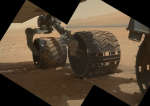 Curiosity: Wheels on Mars
3.06.2013
Could life ever have existed on Mars? To help find out, humanity landed the Curiosity rover on Mars last August. To make sure the car-sized explorer survived the interplanetary trip and dramatic landing intact, the above image and others was taken peering at, under, and around Curiosity.
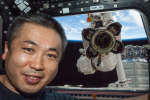 Space Station Robot Forgets Key Again
1.04.2014
Space station robot AFJ013 has forgotten her space lock key again. The frustrated robot was reduced to tapping on a space station window and asking for a human to let her back in -- for the third time this week.
|
January February March April May June July August September October |
|||||||||||||||||||||||||||||||||||||||||||||||||