
|
You entered: NASA
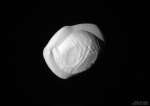 Saturns Moon Pan from Cassini
13.03.2017
Why does Saturn's moon Pan look so odd? Images taken last week from the robotic Cassini spacecraft orbiting Saturn have resolved the moon in unprecedented detail. The surprising images reveal a moon that looks something like a walnut with a slab through its middle.
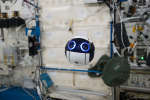 Int Ball Drone Activated on the Space Station
25.07.2017
What if you were followed around by a cute floating ball that kept taking your picture? Then you might be an astronaut on today's International Space Station (ISS). Designed by the Japan Aerospace...
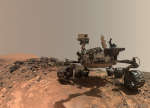 Curiosity Rover Takes Selfie on Mars
20.11.2017
Yes, but have you ever taken a selfie on Mars? The Curiosity rover on Mars has. This selfie was compiled from many smaller images -- which is why the mechanical arm holding the camera is not visible.
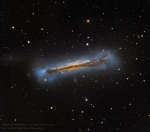 NGC 3682: Sideways Spiral Galaxy
5.09.2018
What do spiral galaxies look like sideways? Featured is a sharp telescopic view of a magnificent edge-on spiral galaxy NGC 3628, a puffy galactic disk divided by dark dust lanes. Of course, this deep galactic portrait puts some astronomers in mind of its popular moniker, The Hamburger Galaxy.
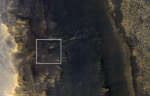 Opportunity After the Storm
4.10.2018
On Mars dust storms can't actually blow spacecraft over, but they can blot out the Sun. Over three months ago a planet-wide dust storm caused a severe lack of sunlight for the Mars rover Opportunity at its location near the west rim of Endeavor crater.
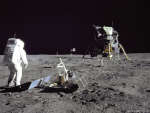 Moonquakes Surprisingly Common
21.07.2019
Why are there so many moonquakes? Analyses of seismometers left on the moon by the Apollo moon landings reveals a surprising number of moonquakes occurring within 100 kilometers of the surface. In fact, 62 moonquakes were detected in data recorded between 1972 and 1977.
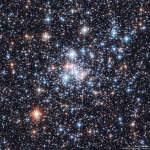 A Stellar Jewel Box: Open Cluster NGC 290
13.10.2019
Jewels don't shine this bright -- only stars do. Like gems in a jewel box, though, the stars of open cluster NGC 290 glitter in a beautiful display of brightness and color. The photogenic cluster, pictured here, was captured in 2006 by the orbiting Hubble Space Telescope.
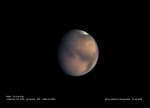 The Red Planet Mars
30.07.2020
Mars looks pretty sharp in this backyard telescope image captured on July 23 from Hoegaarden, Belgium, planet Earth. The Red Planet's bright south polar cap is bathed in sunlight at the top of the inverted view, while the dark feature known as Syrtis Major extends toward the right (eastern) edge.
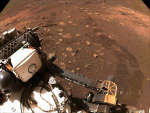 Perseverance Takes a Spin
6.03.2021
After arriving at Jezero Crater on Mars, Perseverance went for a spin on March 4. This sharp image from the car-sized rover's Navcam shows tracks left by its wheels in the martian soil. In preparation for operations on the surface of the Red Planet, its first drive lasted about 33 minutes.
 Stereo Helene
1.06.2024
Get out your red/blue glasses and float next to Helene, small, icy moon of Saturn. Appropriately named, Helene is a Trojan moon, so called because it orbits at a Lagrange point. A Lagrange point is a gravitationally stable position near two massive bodies, in this case Saturn and larger moon Dione.
|
January February March April May June July August September October |
|||||||||||||||||||||||||||||||||||||||||||||||||