
|
You entered: NASA
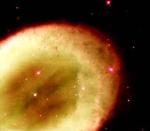 M57: The Ring Nebula
4.05.1998
It looked like a ring on the sky. Hundreds of years ago astronomers noticed a nebula with a most unusual shape. Now known as M57 or NGC 6720, the gas cloud became popularly known as the Ring Nebula.
 The Moving Moons of Saturn
27.06.2006
The moons of Saturn never stop. A space traveler orbiting the ringed giant planet would witness a continuing silent dance where Saturn's multiple moons pass near each other in numerous combinations. Like a miniature Solar System, the innermost moons orbit Saturn the fastest.
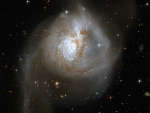 Galaxies Collide in NGC 3256
6.05.2008
Galaxies don't normally look like this. NGC 3256 actually shows a current picture of two galaxies that are slowly colliding. Quite possibly, in hundreds of millions of years, only one galaxy will remain.
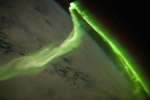 Above Aurora Australis
1.07.2010
On May 29, looking southward from a vantage point about 350 kilometers above the southern Indian Ocean, astronauts onboard the International Space Station watched this enormous, green ribbon shimmering below. Known as aurora australis...
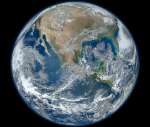 Blue Marble Earth from Suomi NPP
30.01.2012
Behold one of the more detailed images of the Earth yet created. This Blue Marble Earth montage shown above -- created from photographs taken by the Visible/Infrared Imager Radiometer Suite (VIIRS) instrument on board the new Suomi NPP satellite -- shows many stunning details of our home planet.
 Saturns Moon Helene in Color
2.05.2012
Although its colors may be subtle, Saturn's moon Helene is an enigma in any light. The moon was imaged in unprecedented detail last June as the robotic Cassini spacecraft orbiting Saturn swooped to within a single Earth diameter of the diminutive moon.
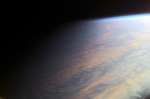 Earth at Twilight
6.04.2013
No sudden, sharp boundary marks the passage of day into night in this gorgeous view of ocean and clouds over our fair planet Earth. Instead, the shadow line or terminator is diffuse and shows the gradual transition to darkness we experience as twilight.
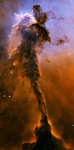 The Fairy of Eagle Nebula
29.09.2013
The dust sculptures of the Eagle Nebula are evaporating. As powerful starlight whittles away these cool cosmic mountains, the statuesque pillars that remain might be imagined as mythical beasts. Pictured above is one of several striking dust pillars of the Eagle Nebula that might be described as a gigantic alien fairy.
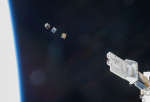 Three CubeSats Released
6.01.2014
Cubes are orbiting the Earth. Measuring ten-centimeters on a side, CubeSats -- each roughly the size of a large coffee mug -- are designed to be inexpensive both to build and to launch. Pictured above, three CubeSats were released from the International Space Station (ISS) last November by the arm of the Japanese Kibo Laboratory module.
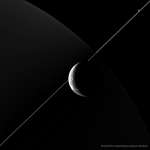 APOD: 2015 July 8 In the Company of Dione
7.07.2015
That is not our Moon. It's Dione, and its a moon of Saturn. The robotic Cassini spacecraft took the featured image during a flyby of Saturn's cratered Moon last month. Perhaps what makes this image so interesting, though, is the background.
|
January February March April May June July August September October |
|||||||||||||||||||||||||||||||||||||||||||||||||