
|
You entered: NASA
 APOD: 2025 March 23 Б Ancient Ogunquit Beach on Mars
23.03.2025
This was once a beach -- on ancient Mars. The featured 360-degree panorama, horizontally compressed, was taken in 2017 by the robotic Curiosity rover that explored the red planet. Named Ogunquit Beach after its terrestrial...
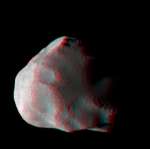 Stereo Helene
29.03.2025
Get out your red/blue glasses and float next to Helene, small, icy moon of Saturn. Appropriately named, Helene is a Trojan moon, so called because it orbits at a Lagrange point. A Lagrange point is a gravitationally stable position near two massive bodies, in this case Saturn and larger moon Dione.
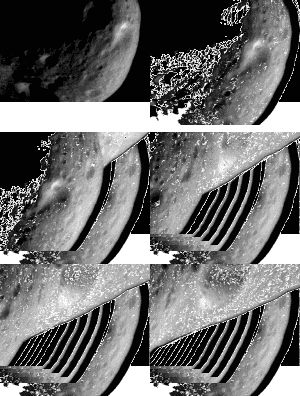 Flying Over Asteroid Eros West End
17.04.2000
The robot spacecraft NEAR Shoemaker continues to orbit asteroid Eros. This condensed 40-minute long time-lapse sequence taken last month shows what it looks like to pass within 200 kilometers of Eros' west end. The north pole of the rotating mountain is toward the bottom of the picture.
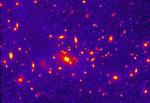 A Massive Cluster In A Young Universe
21.08.1998
Conventional theories suggest that this cluster of galaxies should not exist. Each fuzzy spot in this false-color Hubble Space Telescope image of the central regions of a newly discovered galaxy cluster is a galaxy similar in mass to our own Milky Way.
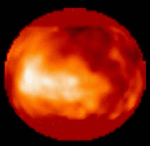 A Glimpse of Titan's Surface
21.10.1995
The surface of Titan, Saturn's largest moon, is normally hidden from view by its thick, hazy atmosphere. However, for the first time astronomers have been able to see surface features in images like the one above, made at near-infrared wavelengths with the Hubble Space Telescope.
 A Black Hole in M87's Center?
5.03.1996
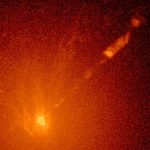
The center of nearby giant galaxy M87 is a dense and violent place. In this 1994 photograph by the Hubble Space Telescope, a disk of hot gas was found to be orbiting at the center of this massive elliptical galaxy. The disk is evident on the lower left of the above photograph.
 Von Braun's Wheel
2.03.1996
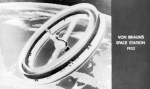
Orbiting 1,075 miles above the Earth, a 250 foot wide, inflated, reinforced nylon "wheel" was conceived in the early 1950s to function as a navigational aid, meteorological station, military platform, and way station for space exploration by rocket pioneer Wernher von Braun.
 Elliptical Galaxy NGC 4881 in Coma
6.11.1996
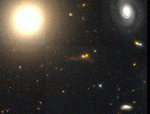
Elliptical galaxies are unlike spiral galaxies and hence unlike our own Milky Way Galaxy. The giant elliptical galaxy named NGC 4881 on the upper left lies at the edge of the giant Coma Cluster of Galaxies.
 Betelgeuse, Betelgeuse, Betelgeuse
16.02.1997
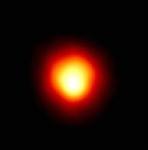
Betelgeuse (sounds a lot like "beetle juice"), a red supergiant star about 600 light years distant, is seen in this Hubble Space Telescope image -- the first direct picture of the surface of a star other than the Sun. A bright, as yet unexplained hotspot is revealed on its surface!
 APOD is Two Years Old Today
16.06.1997
The first Astronomy Picture of the Day (APOD) appeared two years ago today. Pictured above is a scene surrounding the creation of an early APOD, depicting the famous astronomer Tycho Brahe demonstrating a celestial globe to Emperor Rudolph II. The image of a possible optical counterpart to a gamma-ray burst appears on the back wall.
|
January February March April May June July August September October |
|||||||||||||||||||||||||||||||||||||||||||||||||