
|
You entered: NASA
 APOD: 2025 July 7 Б Interstellar Comet 3I ATLAS
7.07.2025
It came from outer space. An object from outside our Solar System is now passing through at high speed. Classified as a comet because of its gaseous coma, 3I/ATLAS is only the third identified macroscopic object as being so alien.
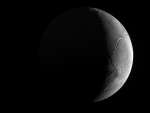 Crescent Enceladus
7.02.2026
Peering from the shadows, the Saturn-facing hemisphere of tantalizing inner moon Enceladus poses in this Cassini spacecraft image. North is up in the dramatic scene captured during November 2016 as Cassini's camera was pointed in a nearly sunward direction about 130,000 kilometers from the moon's bright crescent.
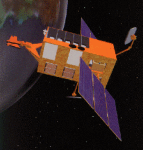 The X-ray Timing Explorer
3.01.1996
Launched Saturday on a Delta rocket, the X-ray Timing Explorer (XTE) will watch the sky for rapid changes in X-rays. XTE carries three separate X-ray telescopes. The Proportional Counter Array (PCA) and the High Energy X-ray Timing Experiment (HEXTE) will provide the best timing information in the widest X-ray energy range yet available.
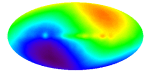 COBE Dipole: Speeding Through the Universe
5.02.1996
Our Earth is not at rest. The Earth moves around the Sun. The Sun orbits the center of the Milky Way Galaxy. The Milky Way Galaxy orbits in the Local Group. The Local Group falls toward the Virgo Cluster of Galaxies.
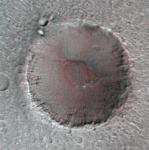 Mars: Big Crater in Stereo
30.04.1998
Get out your red/blue glasses and check out this stereo picture of "Big Crater" on Mars! (Pieces of red and blue or green clear plastic will do. Your right eye should look through...
 Phoebe: Comet Moon of Saturn
12.02.2006
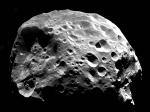
Was Saturn's moon Phoebe once a comet? Images from the robotic Cassini spacecraft taken two years ago when entering the neighborhood of Saturn indicate that Phoebe may have originated in the outer Solar System.
 A Spider Shaped Crater on Mercury
4.02.2008
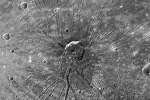
Why does this crater on Mercury look like a spider? When the robotic MESSENGER spacecraft glided by the planet Mercury last month, it was able to image portions of the Sun's closest planet that had never been seen before.
 IC 4406: A Seemingly Square Nebula
27.07.2008
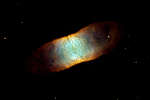
How can a round star make a square nebula? This conundrum comes to light when studying planetary nebulae like IC 4406. Evidence indicates that IC 4406 is likely a hollow cylinder, with its square appearance the result of our vantage point in viewing the cylinder from the side.
 Mercury as Revealed by MESSENGER
8.10.2008
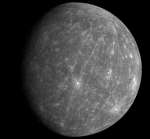
The planet Mercury has been known since history has been recorded, but parts of the Solar System's innermost planet have never been seen like this before. Two days ago the robotic MESSENGER spacecraft buzzed past Mercury for the second time and imaged terrain mapped previously only by comparatively crude radar.
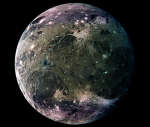 Ganymede Enhanced
20.09.2009
What does the largest moon in the Solar System look like? Ganymede, larger than even Mercury and Pluto, has a surface speckled with bright young craters overlying a mixture of older, darker, more cratered terrain laced with grooves and ridges.
|
January February March April May June July August September October |
|||||||||||||||||||||||||||||||||||||||||||||||||