
|
You entered: NASA
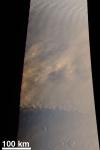 A Martian Dust Storm Approaches
9.08.1999
Batten down the hatches, here comes another Martian dust storm. The thin soil on Mars can be picked up by high winds to create dust storms that sweep down plains and can sometimes envelop most of the planet.
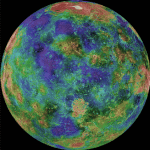 Beneath Venus' Clouds
24.09.1996
If the thick clouds covering Venus were removed, how would the surface appear? Using an imaging radar technique, the Magellan spacecraft was able to lift the veil from the Face of Venus and produce this spectacular high resolution imageof the planet's surface.
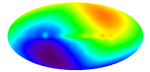 COBE Dipole: Speeding Through the Universe
8.03.1997
Our Earth is not at rest. The Earth moves around the Sun. The Sun orbits the center of the Milky Way Galaxy. The Milky Way Galaxy orbits in the Local Group. The Local Group falls toward the Virgo Cluster of Galaxies.
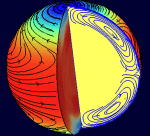 Rivers in the Sun
4.09.1997
The surface of the Sun is shifting. By watching sunspots, it has long been known that our Sun rotates. It was also known that the center of the Sun rotates faster than the poles.
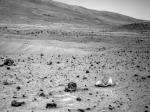 An Unusual Two Toned Rock on Mars
26.01.2006
How did this unusual Martian rock form? The atypical two-toned rock, visible in the lower right of the above image, was photographed a few days ago by the robotic Spirit rover currently rolling across Mars. For now, the environmental processes that created the rock remain a matter of speculation.
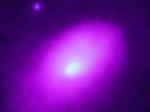 Abell 2142: Clash of the Galaxy Clusters
6.03.2000
Over the course of billions of years, whole clusters of galaxies merge. Above is an X-ray image of Abell 2142, the result of the collision of two huge clusters of galaxies, and one of the most massive objects known in the universe.
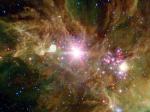 The Snowflake Cluster versus the Cone Nebula
9.05.2007
Strange shapes and textures can be found in the neighborhood of the Cone Nebula. These patterns result from the tumultuous unrest that accompanies the formation of the open cluster of stars known as NGC 2264, the Snowflake cluster.
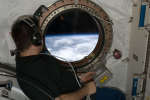 Home from Above
30.12.2008
There's no place like home. Peering out of the window of the International Space Station (ISS), astronaut Greg Chamitoff takes in the planet on which we were all born. About 350 kilometers up, the ISS is high enough so that the Earth's horizon appears clearly curved.
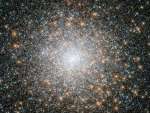 Globular Cluster M15 from Hubble
19.11.2013
Stars, like bees, swarm around the center of bright globular cluster M15. This ball of over 100,000 stars is a relic from the early years of our Galaxy, and continues to orbit the Milky Way's center.
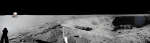 Tranquility Base Panorama
19.07.2019
On July 20, 1969 the Apollo 11 lunar module Eagle safely touched down on the Moon. It landed near the southwestern corner of the Moon's Mare Tranquillitatis at a landing site dubbed Tranquility Base. This panoramic view of Tranquility Base was constructed from the historic photos taken from the lunar surface.
|
January February March April May June July August September October |
|||||||||||||||||||||||||||||||||||||||||||||||||