
|
You entered: NASA
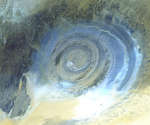 Earths Richat Structure
19.05.2013
What on Earth is that? The Richat Structure in the Sahara Desert of Mauritania is easily visible from space because it is nearly 50 kilometers across. Once thought to be an impact crater, the Richat Structure's flat middle and lack of shock-altered rock indicates otherwise.
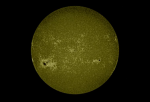 Sunspot Group AR 2192 Crackles
22.10.2014
One of the largest sunspot groups in recent years is now crossing the Sun. Labelled Active Region 2192, it has already thrown a powerful solar flare and has the potential to produce more.
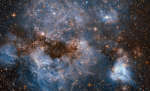 N159 in the Large Magellanic Cloud
28.01.2017
Over 150 light-years across, this cosmic maelstrom of gas and dust is not too far away. It lies south of the Tarantula Nebula in our satellite galaxy the Large Magellanic Cloud a mere 180,000 light-years distant. Massive stars have formed within.
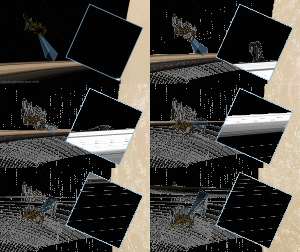 Saturns Rings from the Inside Out
4.09.2017
What do Saturn's rings look like from Saturn? Images from the robotic spacecraft Cassini are providing humanity with this unprecedented vantage point as it nears the completion of its mission. Previous to Cassini's Grand Finale orbits, all images of Saturn's majestic ring system were taken from outside of the rings looking in.
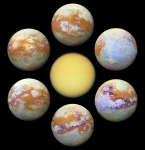 Seeing Titan
18.08.2018
Shrouded in a thick atmosphere, Saturn's largest moon Titan really is hard to see. Small particles suspended in the upper atmosphere cause an almost impenetrable haze, strongly scattering light at visible wavelengths and hiding Titan's surface features from prying eyes.
 The Mountains of NGC 2174
16.01.2021
This fantastic skyscape lies near the edge of NGC 2174 a star forming region about 6,400 light-years away in the nebula-rich constellation of Orion. It follows mountainous clouds of gas and dust carved...
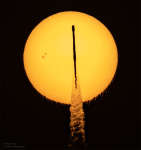 Rocket Transits Rippling Sun
31.05.2022
The launch of a rocket at sunrise can result in unusual but intriguing images that feature both the rocket and the Sun. Such was the case last month when a SpaceX Falcon 9 rocket blasted off from NASA's Kennedy Space Center carrying 53 more Starlink satellites into low Earth orbit.
 Comet C 2023 E1 ATLAS near Perihelion
14.07.2023
Comet C/2023 E1 (ATLAS) was just spotted in March, another comet found by the NASA funded Asteroid Terrestrial-impact Last Alert System. On July 1 this Comet ATLAS reached perihelion, its closest approach to the Sun.
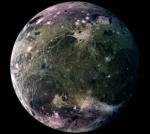 Ganymede Mosaic
4.03.1999
Ganymede, one of the four Galilean moons of Jupiter, is the largest moon in the Solar System. With a diameter of 5,260 kilometers it is even larger than planets Mercury and Pluto and just over three quarters the size of Mars. Ganymede is locked in synchronous rotation with Jupiter.
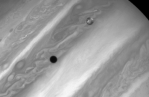 Io's Shadow
7.10.1996
Caught in the act earlier this summer by the Hubble Space Telescope, the volcanic moon Io (above and right of center) and its shadow (black dot) are seen here against Jupiter's clouds.
|
January February March April May June July August September October |
|||||||||||||||||||||||||||||||||||||||||||||||||