
|
You entered: NASA
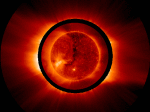 A Wind From The Sun
18.03.2000
A wind from the Sun blows through our Solar System. The behaviour of comet tails as they flapped and waved in this interplanetary breeze gave astronomers the first hint of its existence. Streaming outward at 250-400 miles/second, electrons and ions boiling off the Sun's incredibly hot
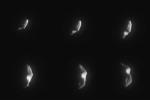 NEAR to Asteroid Eros
5.02.2000
On December 23, 1998 the Near Earth Asteroid Rendezvous (NEAR) spacecraft flew by asteroid 433 Eros. The robotic spacecraft was intended to brake and orbit Eros, but an unexpected shutdown of its main engine caused this plan to be aborted.
 Aeolian Mars
2.02.2000
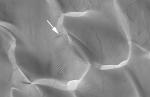
Mars' atmosphere is relatively thin, still when martian winds blow they weather and shape its surface. Like familiar aeolian features on Earth, this field of dunes within Mars' Rabe crater exhibits graceful undulating ridges which can shift as windblown material is deposited on the dunes' windward face and falls away down the steeper leeward slopes.
 The Cat's Eye Nebula
31.10.1999
Three thousand light-years away, a dying star throws off shells of glowing gas. This image from the Hubble Space Telescope reveals The Cat's Eye Nebula to be one of the most complex planetary nebulae known.
 Mountains of Titan
14.12.2006
Peering through the thick, hazy atmosphere of Saturn's largest moon, an infrared camera onboard the Cassini spacecraft recorded this view of the tallest mountains ever seen on Titan. Captured during a flyby...
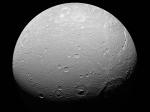 APOD: 2007 August 1- Unusual Cratering on Saturns Dione
1.08.2007
Why does one half of Dione have more craters than the other? Start with the fact that Saturn's moon Dione always has one side that faces Saturn, and always has one side that faces away. This is similar to Earth's Moon.
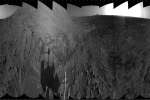 Spirit Rover at Engineering Flats on Mars
7.03.2010
Is it art? If so, the paintbrush was the Spirit robotic rover, the canvas was the soil on Mars, and the artists were the scientists and engineers of the Mars Exploration Rover Mission. This...
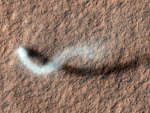 A Dust Devil of Mars
13.04.2012
It was late in the northern martian spring when the HiRISE camera onboard the Mars Reconnaissance Orbiter spied this local denizen. Tracking south and east (down and right) across the flat, dust-covered Amazonis Planitia the core of the whirling dust devil is about 30 meters in diameter.
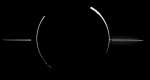 Jupiters Rings Revealed
17.06.2012
Why does Jupiter have rings? Jupiter's rings were discovered in 1979 by the passing Voyager 1 spacecraft, but their origin was a mystery. Data from the Galileo spacecraft that orbited Jupiter from 1995 to 2003 later confirmed that these rings were created by meteoroid impacts on small nearby moons.
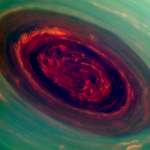 Saturn Hurricane
2.05.2013
Acquiring its first sunlit views of far northern Saturn late last year, the Cassini spacecraft's narrow-angle camera recorded this stunning image of the vortex at the ringed planet's north pole. The false...
|
January February March April May June July August September October |
|||||||||||||||||||||||||||||||||||||||||||||||||