
|
You entered: NASA
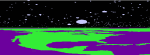 A Star Where Photons Orbit
26.11.1995
The above computer animated picture depicts how a very compact star would look to a nearby observer. The star pictured is actually more compact that any known except a black hole, so it is only hypothetical. The observer is situated at the photon sphere, where photons can orbit in a circle.
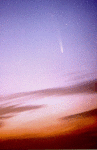 The Sun Sets on Comet Hyakutake
28.04.1996
Comet Hyakutake is seen here just as the Sun sets on April 22. As April draws to a close, Comet Hyakutake will be visible only just after sunset and will be hard to discern against the brightly lit sky.
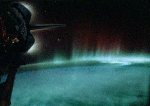 Southern Lights and Shuttle Glow
6.05.1996
A background of distant stars, sinuous and spiky bands of Southern Lights (Aurora Australis), and the faint glow of charged plasma (ionized atomic gas) surrounding the Space Shuttle Discovery's engines give this photo from the STS-39 mission an eerie, otherworldly look.
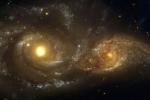 Spiral Galaxies in Collision
9.11.1999
Billions of years from now, only one of these two galaxies will remain. Until then, spiral galaxies NGC 2207 and IC 2163 will slowly pull each other apart, creating tides of matter, sheets of shocked gas, lanes of dark dust, bursts of star formation, and streams of cast-away stars.
 The Solar Wind Emerges
8.02.1999
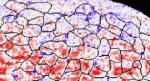
Winds of fast particles blow out from the Sun, but why? Astronomers came a step closer to answering this question recently by making detailed observations of the high-speed wind source with the space-borne Solar and Heliospheric Observatory (SOHO).
 Infrared Mars
3.03.1999
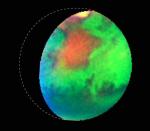
Was Mars wetter and more Earth-like in its distant past? This false-color composite image of Mars is part of the mounting evidence that liquid water once did play a significant role in Martian surface geology.
 Stars of the Galactic Center
13.01.2006
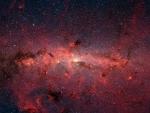
The center of our Milky Way Galaxy is hidden from the prying eyes of optical telescopes by clouds of obscuring dust and gas. But in this stunning vista, the Spitzer Space Telescope's infrared cameras, penetrate much of the dust revealing the stars of the crowded galactic center region.
 Barred Spiral Galaxy NGC 1300
27.08.2006
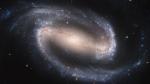
Big, beautiful, barred spiral galaxy NGC 1300 lies some 70 million light-years away on the banks of the constellation Eridanus. This Hubble Space Telescope composite view of the gorgeous island universe is one of the largest Hubble images ever made of a complete galaxy.
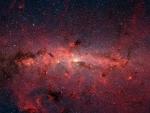 Stars of the Galactic Center
10.02.2007
The center of our Milky Way Galaxy is hidden from the prying eyes of optical telescopes by clouds of obscuring dust and gas. But in this stunning vista, the Spitzer Space Telescope's infrared cameras, penetrate much of the dust revealing the stars of the crowded galactic center region.
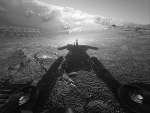 Shadow of a Martian Robot
29.06.2008
What if you saw your shadow on Mars and it wasn't human? Then you might be the Opportunity rover currently exploring Mars. Opportunity and sister robot Spirit have been probing the red planet since early 2004, finding evidence of ancient water, and sending breathtaking images across the inner Solar System.
|
January February March April May June July August September October |
|||||||||||||||||||||||||||||||||||||||||||||||||