
|
You entered: NASA
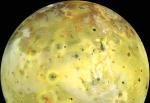 Io in True Color
20.09.1999
The strangest moon in the Solar System is bright yellow. This recently released picture, showing Io's true colors, was taken in July by the Galileo spacecraft currently orbiting Jupiter. Io's colors derive from sulfur and molten silicate rock. The unusual surface of Io is kept very young by its system of active volcanoes.
 Stereo Saturn
30.01.1999
Get out your red/blue glasses and launch yourself into this stereo picture of Saturn! The picture is actually composed from two images recorded weeks apart by the Voyager 2 spacecraft during its visit to the Saturnian System in August of 1981.
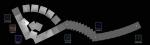 A Solar System Portrait
5.05.1999
As the Voyager 1 spacecraft headed out of our Solar System, it looked back and took a parting family portrait of the Sun and planets. From beyond Pluto, our Solar System looks like a bright star surrounded by faint dots. In the above picture, the Sun is so bright it is blocked out for contrast.
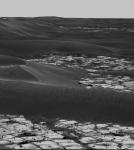 The Drifts of Mars
8.11.2005
What would it be like to walk across Mars? The robot Opportunity rover is currently experiencing what it is like to roll across part of the red planet. It's not always easy -- the rover is being instructed to dodge the deeper drifts of dark sand.
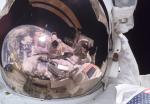 Reflections on Planet Earth
19.07.2006
Catching sight of your reflection in a store window or shiny hubcap can be entertaining and occasionally even inspire a thoughtful moment. So consider this reflective view from 300 kilometers above planet Earth.
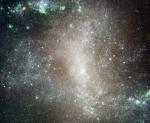 The Star Clusters of NGC 1313
26.01.2007
Like grains of sand on a cosmic beach, individual stars of barred spiral galaxy NGC 1313 are resolved in this sharp composite from the Hubble Space Telescope's Advanced Camera for Surveys (ACS). The inner region of the galaxy is pictured, spanning about 10,000 light-years.
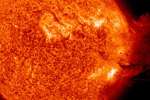 The Sun Unleashed
10.06.2011
On June 7, the Sun unleashed only a medium sized solar flare as rotation carried active regions of sunpots toward the solar limb. But that flare was followed by an astounding gush of magnetized plasma seen erupting at the Sun's edge in this extreme ultraviolet image from the Solar Dynamics Observatory.
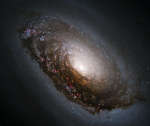 M64: The Sleeping Beauty Galaxy
12.06.2011
The Sleeping Beauty galaxy may appear peaceful at first sight but it is actually tossing and turning. In an unexpected twist, recent observations have shown that the gas in the outer regions of this photogenic spiral is rotating in the opposite direction from all of the stars!
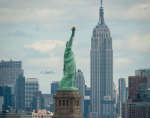 Shuttle Enterprise Over New York
9.05.2012
What's that in the background? Two famous New York City icons stand tall in the above photo taken last week. On the left looms the Statue of Liberty, a universal symbol of freedom, while on the right rises the Empire State Building, now the second largest building in the city.
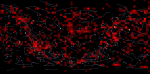 APOD Heatmap
16.06.2014
The first APOD appeared 19 years ago today. To help celebrate, APOD brings you today an all-sky heatmap of (nearly) 19 years of APOD entries. The brighter a region appears on the above heatmap, the more APODs that occur in that region.
|
January February March April May June July August September October |
|||||||||||||||||||||||||||||||||||||||||||||||||