
|
You entered: NASA
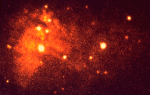 LMC X-1: A Black Hole Candidate
30.12.1995
The strongest source of X-rays in the Large Magellanic Cloud originates from an unusually energetic binary star system. This strong source, dubbed LMC X-1, is thought to be a normal and compact star orbiting each other. Gas stripped of the normal star falls onto the compact star, heats up, and emits X-rays.
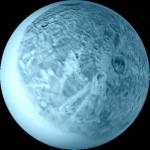 Hamlet of Oberon
31.01.1997
What's in a name? Since 1919, the International Astronomical Union has been charged with the task of establishing "conventional" nomenclature for planets, satellites, and surface features. For the remote Uranian system of moons, namesakes from Shakespearean works have been chosen.
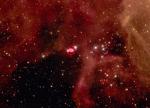 A Supernova Starfield
9.02.1999
Bright stars don't last forever. A bright star similar to others in this field exploded in a spectacular supernova that was witnessed on Earth in 1987. The result is visible even today as unusual rings and glowing gas. The above picture is a composite of recent images taken over several years.
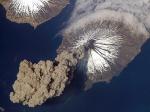 An Alaskan Volcano Erupts
7.06.2006
What is happening to that volcano? It's erupting! The first person to note that the Aleutian Cleveland Volcano was spewing ash was astronaut Jeffrey N. Williams aboard the International Space Station. Looking down...
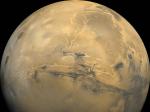 Valles Marineris: The Grand Canyon of Mars
30.07.2006
The largest canyon in the Solar System cuts a wide swath across the face of Mars. Named Valles Marineris, the grand valley extends over 3,000 kilometers long, spans as much as 600 kilometers across, and delves as much as 8 kilometers deep.
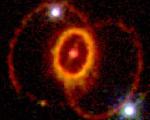 The Mysterious Rings of Supernova 1987A
6.02.2000
What's causing those odd rings in supernova 1987A? In 1987, the brightest supernova in recent history occurred in the Large Magellanic Clouds. At the center of the picture is an object central to the remains of the violent stellar explosion.
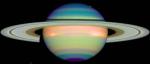 Infrared Saturn
24.07.1999
This delightfully detailed false color image of Saturn was earmarked to celebrate the 8th anniversary of the orbiting Hubble Space Telescope. The picture is a combination of three images taken in January 1998 and shows the lovely ringed planet in reflected infrared light.
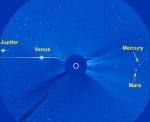 Children of the Sun
16.11.2006
For a moment, planets Jupiter, Venus, Mars, and Mercury all posed near their parent star in this Sun-centered view, recorded on November 11. The picture, from a coronograph onboard the space-based SOlar Heliospheric Observatory, spans 15 degrees with the Sun's size and position indicated by the white circle.
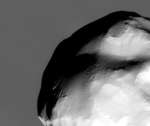 Saturns Moon Helene from Cassini
10.03.2010
What's happening on the surface of Saturn's moon Helene? The moon was imaged in unprecedented detail last week as the robotic Cassini spacecraft orbiting Saturn swooped to within two Earth diameters of the diminutive moon.
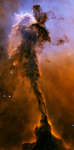 The Fairy of Eagle Nebula
21.08.2011
The dust sculptures of the Eagle Nebula are evaporating. As powerful starlight whittles away these cool cosmic mountains, the statuesque pillars that remain might be imagined as mythical beasts. Pictured above is one of several striking dust pillars of the Eagle Nebula that might be described as a gigantic alien fairy.
|
January February March April May June July August September October |
|||||||||||||||||||||||||||||||||||||||||||||||||