
|
You entered: NASA
 Hurricane Fran's Approach
20.09.1996
Two weeks ago Hurricane Fran, pictured above, struck the east coast of the United States. Hurricanes are huge swirling storms with cloud systems typically larger than a state. Tropical cyclones, called Hurricanes in Earth's Western Hemisphere and Typhoons in the Eastern Hemisphere, get their immense energy from warm evaporated ocean water.
 Phobos Over Mars
15.10.1996
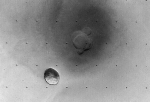
Hurtling through space a mere 3,000 miles above the Martian surface, the diminutive moon Phobos (below and left of center) was imaged against the backdrop of a large shield volcano by the Viking 2 Orbiter in 1977.
 Haunting Mars
31.10.1997
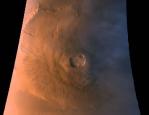
This Halloween, the news about Mars is good news - Mars Global Surveyor will resume aerobraking into a mapping orbit around the haunting red planet. Wide angle cameras onboard the spacecraft recently recorded this shadowy image of Olympus Mons, the Solar System's largest volcano, from an altitude of over 100 miles.
 Southern Lights and Shuttle Glow
22.02.1998
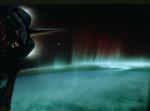
A background of distant stars, sinuous and spiky bands of Southern Lights (Aurora Australis), and the faint glow of charged plasma (ionized atomic gas) surrounding the Space Shuttle Discovery's engines give this photo from the STS-39 mission an eerie, otherworldly look.
 Space Walz
11.02.1997
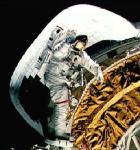
Astronaut Carl Walz waves at his colleagues from the aft end of the Space Shuttle Discovery's payload bay - during a 1993 spacewalk to evaluate tools, tethers, and a foot restraint slated for use in the first Hubble Space Telescope servicing mission.
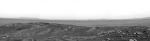 The View from Husband Hill on Mars
7.09.2005
Scroll right to see a breathtaking panorama of Mars from the top of Husband Hill. The image was taken by the robotic rover Spirit now exploring the red planet. Spirit, situated in expansive Gusev Crater, has been exploring the Columbia Hills for some time including climbing Husband Hill over the last few months.
 The Eskimo Nebula from Hubble
9.07.2006
In 1787, astronomer William Herschel discovered the Eskimo Nebula. From the ground, NGC 2392 resembles a person's head surrounded by a parka hood. In 2000, the Hubble Space Telescope imaged the Eskimo Nebula. From space, the nebula displays gas clouds so complex they are not fully understood.
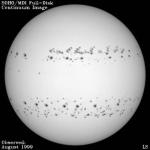 Follow The Spots
21.10.1999
The Sun rotates on its axis about once every 27 days. How can you tell? Just follow the sunspots. This composite picture was constructed from solar images recorded daily by the MDI instrument on board the space-based SOlar and Heliospheric Observatory (SOHO).
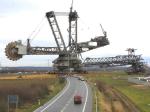 A Bucket Wheel Excavator on Earth
22.11.2006
Please wait while one of the largest mobile machines in the world crosses the road. The machine pictured above is a bucket-wheel excavator used in modern surface mining. Machines like this have given humanity the ability to mine minerals and change the face of planet Earth in new and dramatic ways.
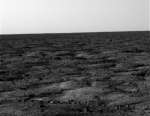 A New Horizon for Phoenix
26.05.2008
This flat horizon stretches across the red planet as seen by the Phoenix spacecraft after yesterday's landing on Mars. Touching down shortly after 7:30pm Eastern Time, Phoenix made the first successful soft landing on Mars, using rockets to control its final speed, since the Viking landers in 1976.
|
January February March April May June July August September October |
|||||||||||||||||||||||||||||||||||||||||||||||||