
|
You entered: NASA
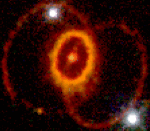 The Mysterious Rings of Supernova 1987a
5.07.1996
What's causing those odd rings in supernova 1987a? In 1987, the brightest supernova in recent history occurred in the Large Magellanic Clouds. At the center of the picture is an object central to the remains of the violent stellar explosion.
 A Rusty Sunset on Mars
4.08.1997
On Mars, sunsets can appear salmon pink. The unusual color is partly due to rust: oxidized iron from Martian dust circulating in the Martian atmosphere. Clouds appear in the morning and evening, but usually evaporate in the midday Sun.
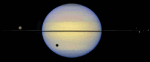 Saturns Rings Seen Sideways
18.10.1998
Saturn's rings are actually very thin. This picture from the Hubble Space Telescope was taken on August 6, 1995 when the rings lined up sideways as seen from Earth. Saturn's largest moon Titan is seen on the left, and Titan's shadow can be seen on Saturn's cloud tops!
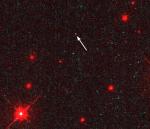 A Lonely Neutron Star
28.11.1998
How massive can a star get without imploding into a black hole? These limits are being tested by the discovery of a lone neutron star in space. Observations by the Hubble Space Telescope have...
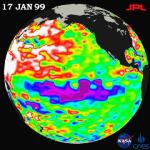 La Nina Earth
15.02.1999
La Niña is a temporary climate change caused by unusually cold water in the central Pacific Ocean. Cold water topping an unusually low sea level is shown as purple in the above false-color picture taken by the orbiting TOPEX/Poseidon satellite in mid-January.
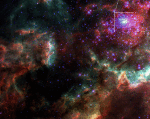 In the Center of 30 Doradus
21.02.1999
In the center of 30 Doradus lies a huge cluster of the largest, hottest, most massive stars known. The center of this cluster, known as R136, is boxed in the upper right portion of the above picture.
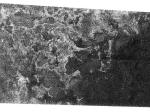 Shoreline Terrain on Saturns Titan
21.09.2005
What could have created this unusual terrain on Saturn's moon Titan? The robotic Cassini spacecraft now orbiting Saturn swooped once again, earlier this month, past the Solar System's most enigmatic moon and radar imaged a rich but unusual region that appears to be some sort of shoreline.
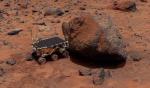 Mars Rocks, Sojourner Rolls
30.10.1999
This sharp color image featuring Mars rock Yogi and the rolling Sojourner robot shows off Yogi's two-toned surface. Yogi appears to be leaning into the prevailing winds causing some to suggest that its color contrast may be caused by the accumulation of rust colored dust on its windward face.
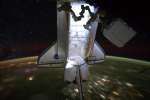 Endeavour s Starry Night
2.06.2011
This luminous night view of the space shuttle orbiter Endeavour, docked with the International Space Station for a final time, was captured on May 28. Orbiting 350 kilometers above planet Earth, Endeavour's payload bay is lit up as it hurtles through Earth's shadow at 27,000 miles per hour.
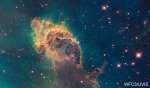 Carina Nebula Dust Pillar
7.02.2015
This cosmic pillar of gas and dust is nearly two light-years wide. The structure lies within one of our galaxy's largest star forming regions, the Carina Nebula, shining in southern skies at a distance of about 7,500 light-years.
|
January February March April May June July August September October |
|||||||||||||||||||||||||||||||||||||||||||||||||