
|
You entered: NASA
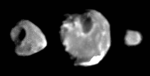 Jupiters Moons Thebe, Amalthea, and Metis
8.05.2000
The robot spacecraft Galileo in orbit around Jupiter has recently photographed the inner moons of Jupiter in greater detail than ever before. These pictures of Thebe, Amalthea, and Metis are shown to scale, and reveal details as small as three kilometers across. Amalthea, by contrast, has a total length of about 200 kilometers.
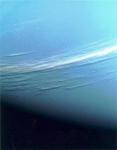 Two Hours Before Neptune
5.10.1999
Two hours before closest approach to Neptune in 1989, the Voyager 2 robot spacecraft snapped this picture. Clearly visible for the first time were long light-colored cirrus-type clouds floating high in Neptune's atmosphere. Shadows of these clouds can even be seen on lower cloud decks.
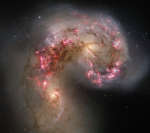 The Antennae Galaxies in Collision
18.07.2010
Two galaxies are squaring off in Corvus and here are the latest pictures. But when two galaxies collide, the stars that compose them usually do not. That's because galaxies are mostly empty space and, however bright, stars only take up only a small amount of that space.
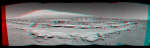 Mount Sharp on the Horizon
8.03.2014
Get out your red/blue glasses (red for the left eye) and look out over this expansive martian landscape. The panoramic stereo view is composed of images from the roving Curiosity's Navcam taken at a rest stop during a 100 meter drive on Sol 548 (February 19).
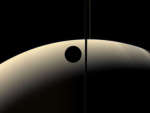 Crescent Rhea Occults Crescent Saturn
3.01.2015
Soft hues, partially lit orbs, a thin trace of the ring, and slight shadows highlight this understated view of the majestic surroundings of the giant planet Saturn. Looking nearly back toward the Sun, the robot Cassini spacecraft now orbiting Saturn captured crescent phases of Saturn and its moon Rhea in color a few years ago.
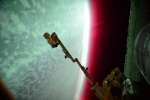 Planet Aurora
26.06.2015
What bizarre alien planet is this ? It's planet Earth of course, seen through the shimmering glow of aurorae from the International Space Station. About 400 kilometers (250 miles) above, the orbiting station is itself within the upper realm of the auroral displays, also watched from the planet's surface on June 23rd.
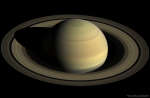 Saturn from Above
25.09.2016
This image of Saturn could not have been taken from Earth. No Earth based picture could possibly view the night side of Saturn and the corresponding shadow cast across Saturn's rings. Since Earth is much closer to the Sun than Saturn, only the day side of the ringed planet is visible from the Earth.
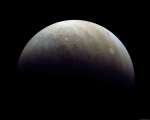 Southern Jupiter from Perijove 3
17.12.2016
Southern Jupiter looms some 37,000 kilometers away in this JunoCam image from December 11. The image data was captured near Juno's third perijove or closest approach to Jupiter, the spacecraft still in its 53 day long looping orbit.
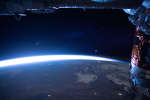 Comet NEOWISE from the ISS
10.07.2020
Rounding the Sun on July 3rd and currently headed for the outer Solar System, Comet NEOWISE (C/2020 F3) has been growing brighter in the predawn skies of planet Earth. From low Earth orbit...
 Artemis 1: Flight Day 13
30.11.2023
On flight day 13 (November 28, 2022) of the Artemis I mission, the Orion spacecraft reached its maximum distance from its home world. Over 430,000 kilometers from Earth in a distant retrograde orbit, Orion surpassed the record for most distant spacecraft designed to carry humans.
|
January February March April May June July August September October |
|||||||||||||||||||||||||||||||||||||||||||||||||