
|
You entered: NASA
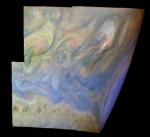 West Of The Great Red Spot
26.12.1997
The turbulent region West of Jupiter's Great Red Spot is highlighted in this recent picture constructed from data recorded by the Galileo spacecraft. The image is color coded to show cloud height and thickness; white clouds are high and thick, light blue clouds are high and thin, and reddish clouds are low.
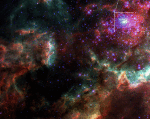 In the Center of 30 Doradus
4.10.1997
In the center of 30 Doradus lies a huge cluster of the largest, hottest, most massive stars known. The center of this cluster, known as R136, is boxed in the upper right portion of the above picture.
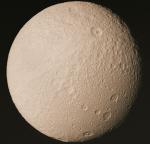 Saturns Moon Tethys
19.05.2002
Tethys is one of the larger and closer moons of Saturn. It was visited by both Voyager spacecraft - Voyager 1 in November 1980 and by Voyager 2 in August 1981. Tethys is now known to be composed almost completely of water ice. Tethys shows a large impact crater that nearly circles the planet.
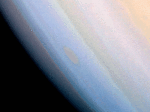 Saturn's Cloud Tops
17.03.1996
This close-up of the tops of Saturn's clouds was taken by the Voyager 1 robot spacecraft as it passed the giant planet in November 1980. Saturn's clouds are mostly composed of hydrogen and helium gas, but the small addition of other elements gives the clouds their colors.
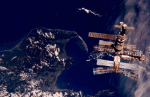 Mir Dreams
3.06.1996
This dream-like image of Mir was recorded by astronauts as the Space Shuttle Atlantis approached the Russian Space Station prior to docking during the STS-76 mission. Sporting spindly appendages and solar pannels, Mir resembles a whimsical flying insect as it orbits above New Zealand's South Island near the Cook Straight.
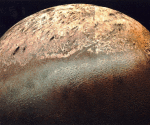 Triton: Neptune's Largest Moon
23.11.1997
On October 10th, 1846, William Lassell was observing the newly discovered planet Neptune. He was attempting to confirm his observation, made just the previous week, that Neptune had a ring. But this time he discovered that Neptune had a satellite as well.
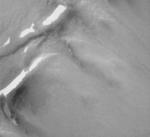 Ski Mars
1.04.1999
These brightly reflecting fields of snow or frost are on the slopes of a crater rim in the northern hemisphere of Mars. They are 500 meters or so long and have lasted through about eight months of the Red Planet's spring and summer weather.
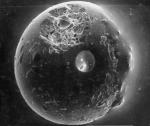 A Spherule from Outer Space
22.03.2000
When a meteorite strikes the Moon, the energy of the impact melts some of the splattering rock, a fraction of which might cool into tiny glass beads. Many of these glass beads were present in lunar soil samples returned to Earth by the Apollo missions.
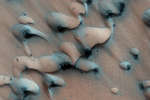 Sand Dunes Thawing on Mars
3.03.2008
What are these strange shapes on Mars? Defrosting sand dunes. As spring now dawns on the Northern Hemisphere of Mars, dunes of sand near the pole, as pictured above, are beginning to thaw. The carbon dioxide and water ice actually sublime in the thin atmosphere directly to gas.
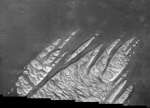 White Rock Fingers on Mars
30.10.2011
What caused this unusual light rock formation on Mars? Intrigued by the possibility that they could be lakebed dried-up, detailed studies of these fingers now indicate a more mundane possibility: volcanic ash. Studying the exact color of the formation indicated the possible volcanic origin.
|
January February March April May June July August September October |
|||||||||||||||||||||||||||||||||||||||||||||||||