
|
You entered: NASA
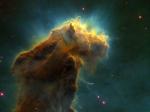 Star EGGs in the Eagle Nebula
22.10.2006
Where do stars form? One place, star forming regions known as "EGGs", are uncovered at the end of this giant pillar of gas and dust in the Eagle Nebula (M16). EGGs, short for evaporating gaseous globules, are dense regions of mostly molecular hydrogen gas that fragment and gravitationally collapse to form stars.
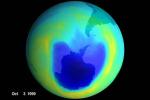 Ozone Hole Reduced
13.10.1999
Although a new ozone hole has formed again this year over the South Pole, this time it is a little bit smaller than the year before. Ozone is important because it shields us from damaging ultraviolet sunlight. Ozone is vulnerable, though, to CFCs and halons being released into the atmosphere.
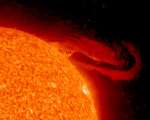 A Solar Prominence Unfurls
4.10.2008
On September 29, this magnificent eruptive solar prominence lifted away from the Sun's surface, unfurling into space over the course of several hours. Suspended in twisted magnetic fields, the hot plasma structure is many times the size of planet Earth and was captured in this view by the Sun-watching STEREO (Ahead) spacecraft.
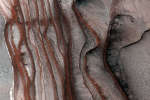 Layers of Cliffs in Northern Mars
6.10.2008
How did these layers of red cliffs form on Mars? No one is sure. The northern ice cap on Mars is nearly divided into two by a huge division named Chasma Boreale. No similar formation occurs on Earth. Pictured above, several dusty layers leading into this deep chasm are visible.
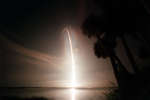 Atlantis to Orbit
17.01.2010
Birds don't fly this high. Airplanes don't go this fast. The Statue of Liberty weighs less. No species other than human can even comprehend what is going on, nor could any human just a millennium ago. The launch of a rocket bound for space is an event that inspires awe and challenges description.
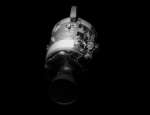 Damage to Apollo 13
17.04.2010
After an oxygen tank exploded and crippled their service module, the Apollo 13 astronauts were forced to abandon plans to make the third manned lunar landing. The extent of the damage is revealed...
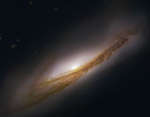 Spiral Galaxy NGC 3190 Almost Sideways
3.05.2010
Some spiral galaxies are seen almost sideways. NGC 3190, one such galaxy, is the largest member of the Hickson 44 Group, one of the nearer groups of galaxies to our own Local Group of galaxies. Pictured above, finely textured dust lanes surround the brightly glowing center of this picturesque spiral.
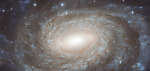 NGC 6384: Spiral Beyond the Stars
22.03.2011
The universe is filled with galaxies. But to see them astronomers must look out beyond the stars of our galaxy, the Milky Way. For example, consider this colorful telescopic view of spiral galaxy NGC 6384, about 80 million light-years away in the direction of the constellation Ophiuchus.
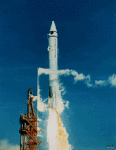 An Atlas Centaur Rocket Launches
14.12.1995
Atlas Centaur rockets have launched over 75 successful unmanned missions. These missions included the Surveyor series - the first vehicles to make soft landings on the Moon, Pioneer 10 and 11 - the first missions...
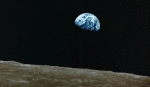 Earth Rise
25.12.1995
During the 1968 Christmas season Frank Borman, James Lovell, and William Anders flew the Apollo 8 command module From the Earth to the Moon and back (launched Dec. 21, achieved 10 lunar orbits, landed Dec. 27).
|
January February March April May June July August September October |
|||||||||||||||||||||||||||||||||||||||||||||||||