
|
You entered: NASA
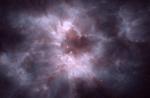 Cocoon of a New White Dwarf
3.12.1996
Like a butterfly, a white dwarf star begins its life by casting off a cocoon that enclosed its former self. In this analogy, however, the Sun would be a caterpillar and the ejected shell of gas would become the prettiest of all!
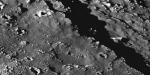 A Big Cliff on Jupiter's Callisto
18.02.1997
Callisto's surface is not without fault. In fact, an explorer crossing the surface of this large moon of Jupiter would need climbing equipment to pass this large, recently discovered fault. The above picture was released last week and was taken in November 1996 by the robot spacecraft Galileo currently orbiting Jupiter.
 A Martian Lake Bed
11.12.1997
Look closely. In this Mars Global Surveyor image of the Martian surface just south of Schiaparelli crater, dark lines appear to criss-cross light colored depressions. One tantalizing possibility is simply that the feature near...
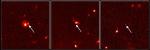 A Distant Destiny
14.01.1998
Watching galaxies recede, observational astronomers of the 20th century discovered an astounding fact - the Universe is expanding. Will it continue to expand forever? The speed of light is finite so looking into the distant Universe is equivalent to looking at the distant past.
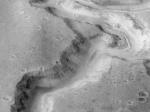 A Martian River Bed
5.02.1998
This canyon on the surface of Mars appears to have been carved by flowing water. Known as Nanedi Vallis, the terraces and channels visible within the canyon strongly suggest that a river of water once ran here.
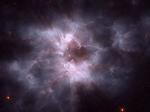 NGC 2440: Cocoon of a New White Dwarf
7.05.2006
Like a butterfly, a white dwarf star begins its life by casting off a cocoon that enclosed its former self. In this analogy, however, the Sun would be a caterpillar and the ejected shell of gas would become the prettiest of all!
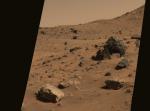 Strangers on Mars
21.07.2006
This view from the winter station of Mars Exploration Rover Spirit, looks across the rock strewn landscape of Gusev Crater. The dark boulders and distant hills are characteristic of the region...
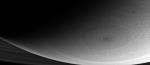 Saturn from Below
10.04.2007
Swooping below Saturn, the Cassini spacecraft spied several strange wonders. Visible in the distance are some of the many complex rings that orbit the Solar System's second largest planet. In the foreground looms the gigantic world itself, covered with white dots that are clouds high in Saturn's thick atmosphere.
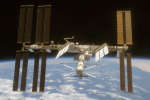 The International Space Station Expands Again
23.06.2008
The developing International Space Station (ISS) has changed its appearance again. Earlier this month, the Space Shuttle orbiter Discovery visited the ISS and added components that included Japan's Kibo Science Laboratory. The entire...
 Lunar View, Solar Eclipse
31.08.2017
Orbiting above the lunar nearside on August 21, the Lunar Reconnaissance Orbiter turned to look back on a bright, Full Earth. As anticipated its Narrow Angle Camera scanned this sharp view of our fair...
|
January February March April May June July August September October |
|||||||||||||||||||||||||||||||||||||||||||||||||