
|
You entered: NASA
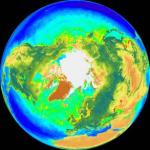 Ocean Planet Pole To Pole
7.10.1998
The Sea-viewing Wide Field-of-view Sensor (SeaWiFS) instrument onboard the orbiting SeaStar spacecraft can map subtle differences in Earth's ocean color. These North (left) and South Pole projections are based on SeaWiFS measurements made between September 1997 and July 1998.
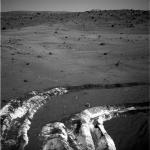 Unusual Bright Soil on Mars
6.04.2006
What is this bright soil on Mars? Several times while rolling across Mars, the treads of the robotic rover Spirit have serendipitously uncovered unusually bright soil. Spirit uncovered another batch unexpectedly last month while rolling toward its winter hibernation location on McCool Hill.
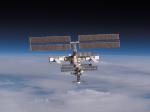 The International Space Station on the Horizon
24.07.2006
This was home. Last week, the STS-121 crew of the Space Shuttle Discovery undocked from the International Space Station (ISS) and returned to Earth. As the shuttle departed the space station, they took the above image. Visible on the ISS are numerous modules, trusses, and long wing-like solar panels.
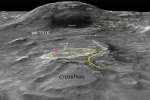 Mars Rover Races to Survive
12.12.2007
The Martian rover Spirit is now in the race of its life. The rolling robot is trying to reach an outpost to spend the winter, but it keeps getting bogged down in soft sand on Mars.
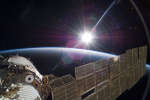 Bright Sun and Crescent Earth from the Space Station
30.11.2009
This was just one more breathtaking view from the International Space Station. The Sun, a crescent Earth, and the long arm of a solar panel were all visible outside a window when the Space Shuttle Atlantis visited the orbiting outpost last week. Reflections from the window and hexagonal lens flares from the camera are superposed.
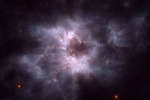 NGC 2440: Cocoon of a New White Dwarf
21.02.2010
Like a butterfly, a white dwarf star begins its life by casting off a cocoon that enclosed its former self. In this analogy, however, the Sun would be a caterpillar and the ejected shell of gas would become the prettiest of all!
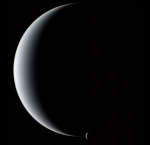 Crescent Neptune and Triton
14.04.2013
Gliding silently through the outer Solar System, the Voyager 2 spacecraft camera captured Neptune and Triton together in crescent phase in 1989. The elegant picture of the gas giant planet and its cloudy moon was taken from behind just after closest approach.
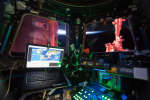 Interior View
22.01.2015
Some prefer windows, and these are the best available on board the International Space Station. Taken on January 4, this snapshot from inside the station's large, seven-window Cupola module also shows off a workstation for controlling Canadarm2.
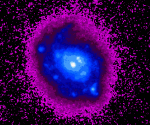 M77: Spiral with a Strange Glow
10.09.1996
Why is M77 surrounded by an ultraviolet glow? M77, also called NGC 1068, appears at first sight to be a relatively normal barred spiral galaxy. But when photographed in the ultraviolet (UV), as shown above in false color, the galaxy sports an ultraviolet halo - shown as violet in the photograph.
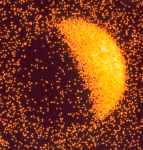 The X-Ray Moon
29.09.1996
This X-Ray image of the Moon was made by the orbiting Roentgen Observatory Satellite (ROSAT) in 1990. It shows three distinct regions: a bright X-ray sky, a bright part of the Moon, and a relatively dark part of the Moon. The bright X-ray sky is due to the diffuse cosmic X-ray background.
|
January February March April May June July August September October |
|||||||||||||||||||||||||||||||||||||||||||||||||