
|
You entered: NASA
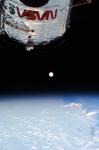 Earth, Moon, Hubble
5.01.2000
The Space Shuttle Discovery Crew was fortunate enough to witness one of the brighter full moon's from orbit two weeks ago during their mission to fix the Hubble Space Telescope. Pictured...
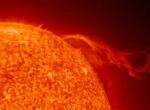 Escape From The Sun
20.11.1997
Twisted magnetic fields arching from the solar surface can trap ionized gas, suspending it in huge looping structures. These majestic plasma arches are seen as prominences above the solar limb. On September 14, this...
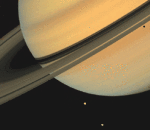 Saturn with Moons Tethys and Dione
31.05.1997
Saturn and two of its larger moons - Tethys and Dione - were photographed by the Voyager 1 spacecraft which flew by the planet in November of 1980. This picture gives an indication of Saturn's extensive ring system, which can be seen casting a shadow on the planet, as does Tethys.
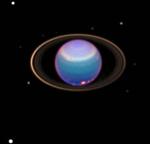 Infrared Uranus
20.10.1998
The Sun's third largest planet usually looks quite dull. Uranus typically appears as a featureless small spot in a small telescope or a featureless large orb in a large telescope. Last August, however...
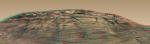 Burns Cliff Anaglyph
4.08.2006
Get out your red/blue glasses and gaze across Burns Cliff along the inner wall of Endurance crater on Mars! The view from the perspective of Mars rover Opportunity is a color anaglyph - two different images are presented to the left and right eyes by color filters to produce the 3D effect.
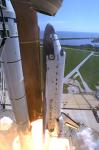 Atlantis to Orbit
13.09.2006
Birds don't fly this high. Airplanes don't go this fast. The Statue of Liberty weighs less. No species other than human can even comprehend what is going on, nor could any human just a millennium ago. The launch of a rocket bound for space is an event that inspires awe and challenges description.
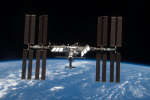 APOD: 2009 April 6 The International Space Station Expands Again
6.04.2009
The developing International Space Station (ISS) has changed its appearance again. In a recently completed mission, the Space Shuttle orbiter Discovery visited the ISS and added components that included a new truss and new solar panels.
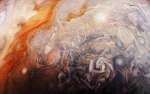 Painting with Jupiter
7.04.2018
Brush strokes of Jupiter's signature atmospheric bands and vortices form this planetary post-impressionist work of art. The creative image uses actual data from the Juno spacecraft's JunoCam. To paint on the digital canvas, a image with light and dark tones was chosen for processing and an oil-painting software filter applied.
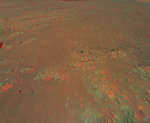 Jezero Crater: Raised Ridges in 3D
7.08.2021
Get out your red-blue glasses and hover over the surface of Mars. Taken on July 24, the 3D color view is from the Mars Ingenuity Helicopter's 10th flight above the Red Planet.
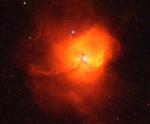 N81: Starbirth in the SMC
27.07.1998
A very young star cluster has been discovered in a neighboring galaxy. The stars found in this cluster, dubbed N81, are so young and massive that they furiously eject matter and light up the surrounding nebula. The ejected stellar winds combine and interact to sculpt beautiful and complex structures.
|
January February March April May June July August September October |
|||||||||||||||||||||||||||||||||||||||||||||||||