
|
You entered: remnants
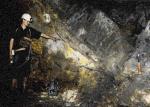 Oklo: Ancient African Nuclear Reactors
16.10.2002
The remnants of nuclear reactors nearly two billion years old were found in the 1970s in Africa. These reactors are thought to have occurred naturally. No natural reactors exist today, as the relative density of fissionable uranium has now decayed below that needed for a sustainable reaction.
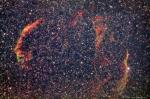 Wisps of the Veil Nebula
3.02.2003
These wisps of gas are all that remain visible of a Milky Way star. Many thousands of years ago that star exploded in a supernova leaving the Veil Nebula, pictured above. At the time...
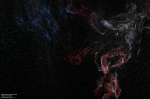 NGC 7841: The Smoke Nebula in Frustriaus
1.11.2013
NGC 7841 is probably known as the Smoke Nebula, found in the modern constellation of Frustriaus, the frustrated astrophotographer. Only a few light-nanoseconds from planet Earth, The Smoke Nebula is not an expanding supernova remnant along the plane of our Milky Way galaxy, though it does look a lot like one.
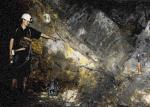 Oklo: Ancient African Nuclear Reactors
19.02.2005
The remnants of nuclear reactors nearly two billion years old were found in the 1970s in Africa. These reactors are thought to have occurred naturally. No natural reactors exist today, as the relative density of fissile uranium has now decayed below that needed for a sustainable reaction.
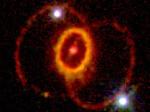 The Mysterious Rings of Supernova 1987A
6.01.2007
What's causing those odd rings in supernova 1987A? In 1987, the brightest supernova in recent history occurred in the Large Magellanic Clouds. At the center of the picture is an object central to the remains of the violent stellar explosion.
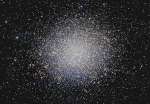 Millions of Stars in Omega Centauri
15.06.2011
Featured in this sharp telescopic image, globular star cluster Omega Centauri (NGC 5139) is some 15,000 light-years away. Some 150 light-years in diameter, the cluster is packed with about 10 million stars much older than the Sun.
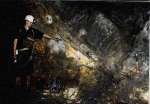 Oklo: Ancient African Nuclear Reactors
12.09.2010
The remnants of nuclear reactors nearly two billion years old were found in the 1970s in Africa. These reactors are thought to have occurred naturally. No natural reactors exist today, as the relative density of fissile uranium has now decayed below that needed for a sustainable reaction.
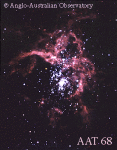 The Violent Star Cluster 30 Doradus
23.05.1996
The largest, most violent star forming region known in the whole Local Group of galaxies lies in our neighboring galaxy the LMC. Were 30 Doradus at the distance of the Orion Nebula -- a local star forming region -- it would take up fully half the sky.
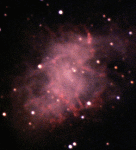 M1: The Crab Nebula
25.07.1995
In the year 1054 a star in the constellation of Taurus exploded in a spectacular supernova so bright it appeared to dominate the sky except for the Sun and Moon for many days. It left behind one of the most brilliant nebulae, listed first in Charles Messier's list of nebulous sky objects.
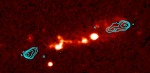 An Energetic Radio Galaxy
29.09.1995
The radio and optical emission seen in the above superposed images of the radio galaxy 3C368 indicate that energetic processes are at work. A radio galaxy is a galaxy that is visible to radio telescopes. A large radio signal usually indicates very powerful phenomena.
|
January February March April May June July August September October |
|||||||||||||||||||||||||||||||||||||||||||||||||