
|
You entered: remnants
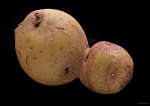 Asteroid or Potato
1.04.2020
Is this asteroid Arrokoth or a potato? Perhaps, after all the data was beamed back to Earth from NASA's robotic New Horizons spacecraft, the featured high resolution image of asteroid Arrokoth was constructed. Perhaps, alternatively, the featured image is of a potato. Let's consider some facts.
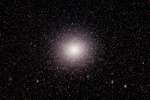 Millions of Stars in Omega Centauri
31.03.2010
Featured in the sharp telescopic image, globular star cluster Omega Centauri (NGC 5139) is some 15,000 light-years away and 150 light-years in diameter. Packed with about 10 million stars much older than...
 Maria Mitchell Inspires a Generation
1.10.1997
"Do not look at stars as bright spots only - try to take in the vastness of the universe." Today is the 150th anniversary of the day Maria Mitchell swept the sky with her telescope and discovered the comet of 1847 (comet Mitchell 1847VI).
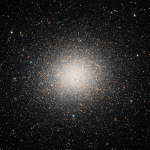 Millions of Stars in Omega Centauri
24.08.2019
Globular star cluster Omega Centauri, also known as NGC 5139, is some 15,000 light-years away. The cluster is packed with about 10 million stars much older than the Sun within a volume about 150 light-years in diameter.
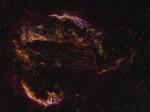 The Veil Nebula Unveiled
6.12.2005
These wisps of gas are all that remain visible of a Milky Way star. Many thousands of years ago that star exploded in a supernova leaving the Veil Nebula, pictured above. At the time...
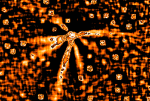 Seven Jets from Comet Hale-Bopp
13.11.1996
Comet Hale-Bopp is turning out to be quite unusual. One reason is the great amount of jet activity at such a large distance from the Sun. In the above false-color image, no less than seven jets can be seen emanating from Hale-Bopp's coma.
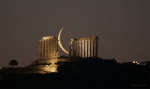 APOD: 2023 February 28 Б Crescent Moon Beyond Greek Temple
28.02.2023
Why is a thin crescent moon never seen far from a horizon? Because the only geometry that gives a thin crescent lunar phase occurs when the Moon appears close to the Sun in the sky.
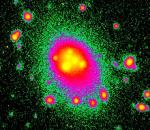 A3827: Cluster Cannibal
31.08.1998
It was mealtime in galaxy cluster Abell 3827. The hungry cluster dominant galaxy in A3827's center is seen being fed. Breakfast included five smaller galaxies unfortunate enough to wander too close to the cluster's central supergiant galaxy. The remnants of these five galaxies can be seen in the center of this false-color picture.
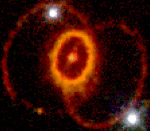 The Mysterious Rings of Supernova 1987a
5.07.1996
What's causing those odd rings in supernova 1987a? In 1987, the brightest supernova in recent history occurred in the Large Magellanic Clouds. At the center of the picture is an object central to the remains of the violent stellar explosion.
 The Frothy Milky Way
2.05.1998
Astronomers have discovered that looking at dust along the plane of our Milky Way Galaxy is a bit like looking into a frothy glass of beer. The dust between stars in our galaxy appears...
|
January February March April May June July August September October |
|||||||||||||||||||||||||||||||||||||||||||||||||