
|
You entered: remnants
 APOD: 2025 September 17 Б Nebulas and Clusters in Sagittarius
17.09.2025
Can you spot famous celestial objects in this image? 18th-century astronomer Charles Messier cataloged only two of them: the bright Lagoon Nebula (M8) at the bottom, and the colorful Trifid Nebula (M20) at the upper right.
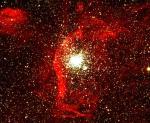 NGC 1850: Gas Clouds and Star Clusters
29.03.1999
There's nothing like it in our own Galaxy. Globular clusters as young as NGC 1850 don't exist here. Globular clusters only 40 millions of years old can still be found in the neighboring LMC galaxy, though, but perhaps none so unusual as NGC 1850.
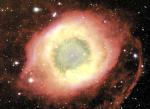 The Helix Nebula from CFHT
28.08.2000
One day our Sun may look like this. The Helix Nebula is the closest example of a planetary nebula created at the end of the life of a Sun-like star. The outer gasses of the star expelled into space appear from our vantage point as if we are looking down a helix.
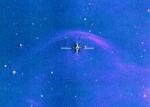 Runaway Star
3.12.1997
Runaway stars are massive stars traveling rapidly through interstellar space. Like a ship plowing through the interstellar medium, runaway star HD 77581 has produced this graceful arcing bow wave or "bow shock" - compressing the gaseous material in its path.
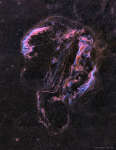 The Ghostly Veil Nebula
31.10.2019
A ghostly visage on a cosmic scale, these remains of shocked, glowing gas haunt planet Earth's sky toward the constellation of Cygnus and form the Veil Nebula. The nebula itself is a large supernova remnant, an expanding cloud born of the death explosion of a massive star.
 The Antlia Cluster of Galaxies
18.10.2016
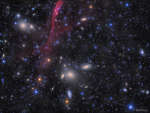
Galaxies dot the sky in this impressively wide and deep image of the Antlia Cluster. The third closest cluster of galaxies to Earth after Virgo and Fornax, the Antlia cluster is known for its compactness and its high fraction of elliptical galaxies over (spirals.
 IC1340 in the Eastern Veil
26.09.2003
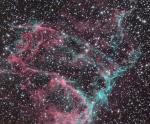
These ghostly filaments of interstellar gas are just a small part of the expansive Veil Nebula, seen against a rich field of background stars in the long-necked constellation Cygnus. Also known as the Cygnus...
 Old Planetary Dust Disks Found by SST
19.10.2004
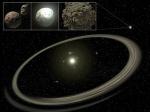
Why are some older stars surrounded by dust? Observations from the Spitzer Space Telescope by a team led by George Rieke (U. Arizona) were expected to show that young stars, on the order of one million years old, have large dust disks, while relatively older stars, between 10 and 100 million years old, have none.
 NGC 6960: The Witch's Broom Nebula
23.08.2000
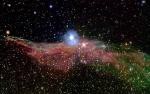
Ten thousand years ago, before the dawn of recorded human history, a new light must suddenly have appeared in the night sky and faded after a few weeks. Today we know this light was an exploding star and record the colorful expanding cloud as the Veil Nebula.
 The Star Pillars of Sharpless 171
18.10.2009
Towering pillars of cold gas and dark dust adorn the center star forming region of Sharpless 171. An open cluster of stars is forming there from the gas in cold molecular clouds. As energetic...
|
January February March April May June July August September October |
|||||||||||||||||||||||||||||||||||||||||||||||||