
|
You entered: remnants
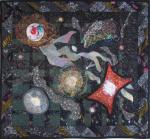 What the Hubble Saw
25.11.2004
In this striking 41 inch by 38 inch quilt, astronomy enthusiast Judy Ross has interpreted some of the Hubble Space Telescope's best galactic and extragalactic vistas. Featured in past APODs, clockwise from...
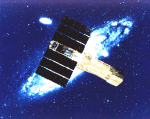 ASCA X-Ray Observatory
20.02.1996
Today marks the third anniversary of the launch of the Advanced Satellite for Cosmology and Astrophysics (ASCA; renamed from Astro D when launched). ASCA, seen here superposed on galaxy M31, is a Japanese satellite for which NASA has provided some scientific equipment. ASCA carries four large-area X-ray telescopes.
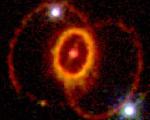 The Mysterious Rings of Supernova 1987A
6.02.2000
What's causing those odd rings in supernova 1987A? In 1987, the brightest supernova in recent history occurred in the Large Magellanic Clouds. At the center of the picture is an object central to the remains of the violent stellar explosion.
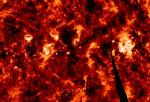 The Frothy Milky Way
9.10.1999
Astronomers have discovered that looking at dust along the plane of our Milky Way Galaxy is a bit like looking into a frothy glass of beer. The dust between stars in our galaxy appears...
 The Frothy Milky Way
24.04.1997
Astronomers have recently discovered that looking at dust along the plane of our Milky Way Galaxy is a bit like looking into a frothy glass of beer. The dust between stars in our galaxy...
 NGC 1850: Gas Clouds and Star Clusters
24.12.2000
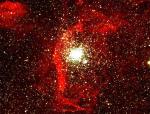
There's nothing like it in our own Galaxy. Globular clusters as young as NGC 1850 don't exist here. Globular clusters only 40 millions of years old can still be found in the neighboring LMC galaxy, though, but perhaps none so unusual as NGC 1850.
 The Mysterious Rings of Supernova 1987A
5.03.2017
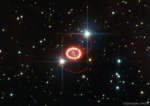
What's causing those odd rings in supernova 1987A? Thirty years ago, in 1987, the brightest supernova in recent history was seen in the Large Magellanic Cloud. At the center of the featured picture is an object central to the remains of the violent stellar explosion.
 NGC 3242: The Ghost of Jupiter
29.10.2005
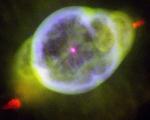
After a star like the Sun completes fusion in its core, it throws off its outer layers in a brief, beautiful cosmic display called a planetary nebula. NGC 3242 is such a planetary nebula, with the stellar remnant white dwarf star visible at the center.
 NGC 3242: The 'Ghost of Jupiter' Planetary Nebula
31.03.1997
It's a weed, it's Jupiter, no it's - actually planetary nebula NGC 3242. After a star like our Sun completes fusion in its core, it throws off its outer layers it a striking display called a planetary nebula.
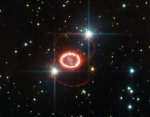 The Mysterious Rings of Supernova 1987A
26.02.2012
What's causing those odd rings in supernova 1987A? Twenty five years ago, in 1987, the brightest supernova in recent history was seen in the Large Magellanic Clouds. At the center of the above picture is an object central to the remains of the violent stellar explosion.
|
January February March April May June July August September October |
|||||||||||||||||||||||||||||||||||||||||||||||||