
|
You entered: Moon
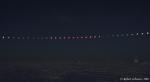 South Pole Lunar Eclipse
7.09.2007
The Moon was up continuously for 14 days in August -- when viewed from the South Pole. But during the total lunar eclipse on August 28, it circled only about 10 degrees above the horizon.
 Eclipse Shirt 2009
29.01.2009
Of course, everyone is concerned about what to wear to a solar eclipse. This is a great example though, especially for the first eclipse of the International Year of Astronomy 2009. In the picture...
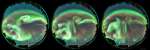 Auroral Substorm over Yellowknife
25.03.2011
Intense auroral activity flooded the night with shimmering colors on February 24, captured here from a lodge near the city of Yellowknife in northern Canada. The stunning sequence (left to right) of three all-sky exposures, taken at 30 second intervals, shows rapid changes in dancing curtains of northern lights against a starry background.
 APOD: 2015 July 11 Geology on Pluto
11.07.2015
Pluto is coming into focus. As the robotic New Horizons spacecraft bears down on this unexplored world of the distant Solar System, new features on its surface are becoming evident. In the displayed image...
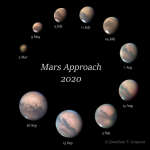 Mars Approach 2020
6.10.2020
Look to the east just after sunset tonight and you'll see a most impressive Mars. Tonight, Mars will appear its biggest and brightest of the year, as Earth passes closer to the red planet than it has in over two years -- and will be again for another two years.
 The Elephant s Trunk in Cepheus
21.11.2024
Like an illustration in a galactic Just So Story, the Elephant's Trunk Nebula winds through the emission region and young star cluster complex IC 1396, in the high and far off constellation of Cepheus. Also known as vdB 142, this cosmic elephant's trunk is over 20 light-years long.
 Rima Hyginus
22.02.2025
Rima Hyginus is a spectacular fissure, some 220 kilometers long, found near the center of the lunar near side. Easy to spot in telescopic views of the Moon, it stretches top left to bottom right across this lunar closeup. The image was made with exaggerated colors that reflect the mineral composition of the lunar soil.
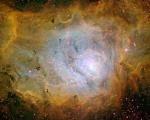 The Lagoon Nebula in Three Colors
20.08.2001
The bright Lagoon Nebula is home to a diverse array of astronomical objects. Particularly interesting sources include a bright open cluster of stars and several energetic star-forming regions. When viewed by eye, cluster light...
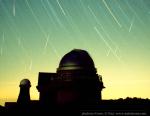 Leonids Over Korean Observatory
12.12.2001
There were two peaks to this year's Leonid Meteor Shower. The first peak was best seen during the early morning hours of November 18 in North America, while the second peak, almost twice the intensity of the first, occurred eight hours later and was best seen from Asia.
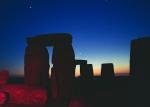 Planets Over Stonehenge
9.05.2002
Stonehenge, four thousand year old monument to the Sun, provides an appropiate setting for this delightful snapshot of the Sun's children gathering in planet Earth's sky. While the massive stone structure dates from around 2000 B.C.
|
January February March April May June July August September October |
|||||||||||||||||||||||||||||||||||||||||||||||||