
|
You entered: Moon
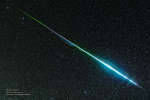 A Rainbow Geminid Meteor
19.12.2018
Meteors can be colorful. While the human eye usually cannot discern many colors, cameras often can. Pictured is a Geminid captured by camera during last week's meteor shower that was not only impressively bright, but colorful.
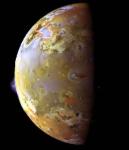 Io: The Prometheus Plume
22.06.2002
Two sulfurous eruptions are visible on Jupiter's volcanic moon Io in this color composite Galileo image. On the left, over Io's limb, a new bluish plume rises about 86 miles above the surface of a volcanic caldera known as Pillan Patera.
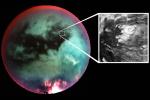 Titan s Cryovolcano
10.06.2005
Investigators suspect the domed feature detailed above is an ice volcano, or cryovolcano, seen in infrared light through the hazy atmosphere on Saturn's moon Titan. Since Titan's surface temperature is around -180...
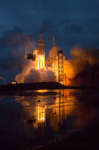 Orion Launch
5.12.2014
Headed for two orbits of planet Earth and a splashdown in the Pacific, Orion blazed into the early morning sky on Friday at 7:05am ET. The spacecraft was launched atop a United Launch Aliance Delta IV Heavy rocket from Cape Canaveral Air Force Station in Florida.
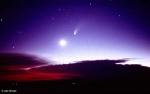 Hale-Bopp: The Crowd Pleaser Comet
9.07.1998
In 1997, the bright comet Hale-Bopp may have become the most viewed comet in history -- visible even to casual skywatchers in light polluted cities around the globe. In this picture, taken by photographer...
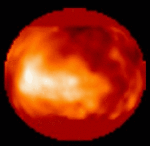 A Glimpse of Titan's Surface
21.10.1995
The surface of Titan, Saturn's largest moon, is normally hidden from view by its thick, hazy atmosphere. However, for the first time astronomers have been able to see surface features in images like the one above, made at near-infrared wavelengths with the Hubble Space Telescope.
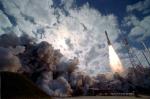 New Horizons Launches to Pluto
24.01.2006
Destination: Pluto. The New Horizons spacecraft roared off its launch pad at Cape Canaveral in Florida, USA last week toward adventures in the distant Solar System. The craft is one of the fastest spaceships...
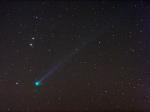 Unexpected Comet Pojmanski Now Visible
6.03.2006
Have you ever seen a comet? Comets bright enough to be visible to the unaided eye appear only every few years. Right now, however, a new comet has brightened unexpectedly and is visible as a faint streak to the unaided northern observer in the eastern morning sky just before sunrise. Binoculars may help.
 Europa Rising
7.05.2007
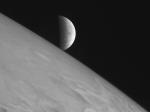
When passing Jupiter on your way to Pluto, what should you look for? NASA pondered just this question recently, and the response from one space enthusiast was to capture the above breathtaking moonrise.
 M13: A Great Globular Cluster of Stars
27.07.2016
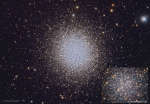
M13 is one of the most prominent and best known globular clusters. Visible with binoculars in the constellation of Hercules, M13 is frequently one of the first objects found by curious sky gazers seeking celestials wonders beyond normal human vision.
|
January February March April May June July August September October |
|||||||||||||||||||||||||||||||||||||||||||||||||