
|
You entered: Moon
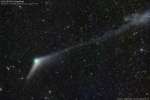 Comet Catalina Tails
1.01.2016
A new year's treat for binoculars, as 2016 begins Comet Catalina (C/2013 US10) now sweeps through planet Earth's predawn skies near bright Arcturus, alpha star of Bootes. But this telescopic mosaic from December 21 follows the pretty tails of the comet across a field of view as wide as 10 full moons.
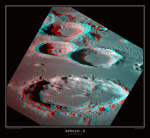 Southwest Mare Fecunditatis
3.03.2018
Frank Borman, James Lovell, and William Anders journeyed from Earth to the Moon and back again in December of 1968. From lunar orbit, their view of craters in southwest Mare Fecunditatis is featured in this stereo anaglyph, best experienced from armchairs on planet Earth with red/blue glasses.
 APOD: 2024 February 14 Б Rosette Deep Field
14.02.2024
Can you find the Rosette Nebula? The large, red, and flowery-looking nebula on the upper left may seem the obvious choice, but that is actually just diffuse hydrogen emission surrounding the Cone and Fox Fur Nebulas.
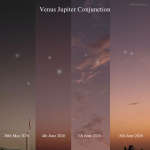 APOD: 2026 June 14 Б 10 Days of Venus and Jupiter
14.06.2026
Venus and Jupiter may have caught your attention lately. The recent close conjunction of the two brightest planets in recent evening skies has been hard to miss. With Jupiter at the top, starting...
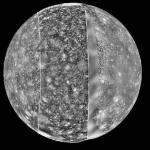 Callisto Full Face
9.12.1996
Callisto's surface shows its age. While probably formed at the same time as Io, the difference between the surfaces of these two moons of Jupiter could hardly be greater. Io's surface is young, shows practically no impact craters, and is continually being repaved by the lava exploding from its many large volcanoes.
 Luna 9: First Soft Lander
25.08.1996
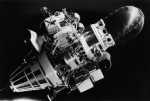
The Luna 9 spacecraft above performed the first soft landing on another planetary body. Following a series of failures, the Soviet probe touched down in the Moon's Oceanus Procellarum region February 3, 1966.
 Zimbabwe Solar Eclipse
6.12.2002
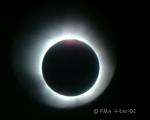
Normally hidding from view in the glare of the Sun, the shy solar corona came out to play Wednesday as a total solar eclipse graced morning skies over southern Africa. This telescopic image...
 IC1340 in the Eastern Veil
26.09.2003
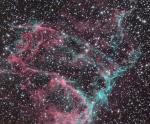
These ghostly filaments of interstellar gas are just a small part of the expansive Veil Nebula, seen against a rich field of background stars in the long-necked constellation Cygnus. Also known as the Cygnus...
 A Solar Eclipse Painting from the 1700s
28.01.2008
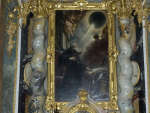
Is this painting the earliest realistic depiction of a total eclipse of the Sun? Some historians believe it is. The above painting was completed in 1735 by Cosmas Damian Asam, a painter and architect famous in early eighteenth century Germany.
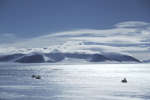 Searching for Meteorites in Antarctica
7.09.2008
Where is the best place on Earth to find meteorites? Although meteors fall all over the world, they usually just sink to the bottom of an ocean, are buried by shifting terrain, or are easily confused with terrestrial rocks.
|
January February March April May June July August September October |
|||||||||||||||||||||||||||||||||||||||||||||||||