
|
You entered: Moon
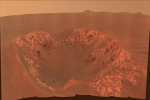 Intrepid Crater on Mars
8.12.2010
The robotic rover Opportunity has chanced across another small crater on Mars. Pictured above is Intrepid Crater, a 20-meter across impact basin slightly larger than Nereus Crater that Opportunity chanced across last year. The above image is in approximately true color but horizontally compressed to accommodate a wide angle panorama.
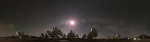 The View from Chajnantor
23.11.2011
From an altitude of over 5,000 meters, the night sky view from Chajnantor Plateau in the Chilean Andes is breathtaking in more ways than one. The dark site's rarefied atmosphere, at about 50 percent sea level pressure, is also extremely dry.
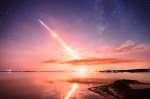 LADEE Launch Streak
11.09.2013
On September 6, a starry night and the Milky Way witnessed the launch of a Minotaur V rocket from NASA's Wallops Flight Facility on Wallops Island, Virginia. So did a large part of the eastern United States, as the spectacular night launch was easily visible even from light polluted urban areas.
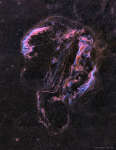 The Ghostly Veil Nebula
31.10.2019
A ghostly visage on a cosmic scale, these remains of shocked, glowing gas haunt planet Earth's sky toward the constellation of Cygnus and form the Veil Nebula. The nebula itself is a large supernova remnant, an expanding cloud born of the death explosion of a massive star.
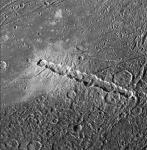 Ganymede: Torn Comet Crater Chain
15.12.2001
This striking line of 13 closely spaced craters on Jupiter's moon Ganymede was photographed by the Galileo spacecraft in 1997. The picture covers an area about 120 miles wide and the chain of craters cuts across a sharp boundary between dark and light terrain. What caused this crater chain?
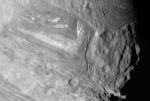 Miranda, Chevron, and Alonso
6.03.1999
Miranda is a bizarre world which surely had a tempestuous past. The innermost of the larger Uranian moons, Miranda is almost 300 miles in diameter and was discovered in 1948 by American planetary astronomer Gerard Kuiper.
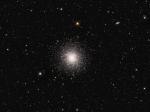 M13: The Great Globular Cluster in Hercules
18.05.2007
In 1714, Edmond Halley noted that M13 "shows itself to the naked eye when the sky is serene and the Moon absent." Of course, M13 is now modestly recognized as the Great Globular Cluster in Hercules, one of the brightest globular star clusters in the northern sky.
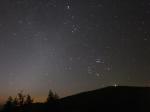 Mysterious Streaks Over Turkey
15.08.2007
What are they? Five streaks near the bottom of the above image taken near Ankara, Turkey on Sunday would be identified at first glance as meteors from the Perseids meteor shower peaking just that night. Unexpectedly, however, these streaks do not point back to the Perseids radiant in Perseus. Their origin is therefore somewhat unclear.
 Shocked by Supernova 1987A
27.02.2012
Twenty five years ago, the brightest supernova of modern times was sighted. Over time, astronomers have watched and waited for the expanding debris from this tremendous stellar explosion to crash into previously expelled material.
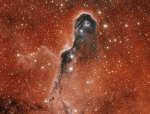 An Unusual Globule in IC 1396
14.04.2014
Is there a monster in IC 1396? Known to some as the Elephant's Trunk Nebula, parts of gas and dust clouds of this star formation region may appear to take on foreboding forms, some nearly human. The only real monster here, however, is a bright young star too far from Earth to hurt us.
|
January February March April May June July August September October |
|||||||||||||||||||||||||||||||||||||||||||||||||