
|
You entered: Moon
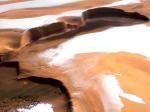 Steep Cliffs on Mars
15.03.2005
Vertical cliffs of nearly two kilometers occur near the North Pole of Mars. Also visible in the above image of the Martian North Polar Cap are red areas of rock and sand, white areas of ice, and dark areas of unknown composition but hypothesized to be volcanic ash.
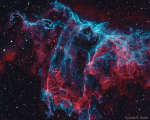 NGC 6995: The Bat Nebula
25.11.2019
Do you see the bat? It haunts this cosmic close-up of the eastern Veil Nebula. The Veil Nebula itself is a large supernova remnant, the expanding debris cloud from the death explosion of a massive star.
 APOD: 2023 June 20 Б The Nandu in the Milky Way
20.06.2023
Have you seen the bird in the Milky Way? Beyond the man in the Moon, the night sky is filled with stories, and cultures throughout history have projected some of their most enduring legends onto the stars and dust above. Generations of people see these celestial icons, hear their associated stories, and pass them down.
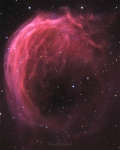 APOD: 2026 September 29 Б Sh2 188: The Shrimp Nebula
29.09.2026
What causes the swirl in the Shrimp Nebula? Its high speed is likely. What is sure is that Sh2-188 is one of the larger planetary nebulas on the night sky, by angular size, spanning about half the diameter of the Moon.
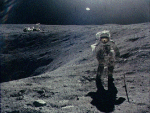 Apollo 16: Exploring Plum Crater
20.12.1997
Apollo 16 spent three days on Earth's Moon in April 1972. The fifth lunar landing mission out of six, Apollo 16 was famous for deploying and using an ultraviolet telescope as the first lunar observatory, and for collecting rocks and data on the mysterious lunar highlands. In the above picture, astronaut John W.
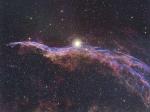 NGC 6960: The Witchs Broom Nebula
2.03.2004
Ten thousand years ago, before the dawn of recorded human history, a new light must suddenly have appeared in the night sky and faded after a few weeks. Today we know this light was an exploding star and record the colorful expanding cloud as the Veil Nebula.
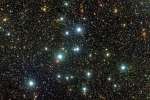 M39: Open Cluster in Cygnus
12.04.2009
Lying just at the limit of human perception is a picturesque starfield containing one of the larger open clusters on the northern sky. Spanning an angle larger than the Moon, M39's relatively few stars lie only about 800 light years distant toward the constellation of Cygnus.
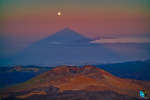 A Triangular Shadow of a Large Volcano
5.07.2011
Why does the shadow of this volcano look like a triangle? The Mount Teide volcano itself does not have the strictly pyramidal shape that its geometric shadow might suggest. The triangle shadow phenomena is not unique to the Mt. Teide, though, and is commonly seen from the tops of other large mountains and volcanoes.
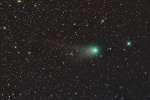 Tails of Comet Garradd
20.10.2011
A good target for binoculars and small telescopes, Comet Garradd (C/2009 P1) now shines in planet Earth's evening skies, a steady performer but just below naked-eye visibility. Telescopic images like this composite from...
 Juno Approaching Jupiter
1.07.2016
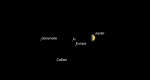
Approaching over the north pole after nearly a five-year journey, Juno enjoys a perspective on Jupiter not often seen, even by spacecraft from Earth that usually swing by closer to Jupiter's equator. Looking...
|
January February March April May June July August September October |
|||||||||||||||||||||||||||||||||||||||||||||||||