
|
You entered: dark
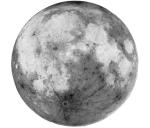 Full Moondark
28.07.2007
The brilliant full Moon might not look quite like this to skygazers next Monday, but the image is a mosaic of 18 digital frames recorded when the Moon was only about seven hours past its exact full phase or time of maximum illumination as viewed from Earth.
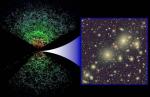 The SDSS 3D Universe Map
28.10.2003
The latest map of the cosmos again indicates that dark matter and dark energy dominate our universe. The Sloan Digital Sky Survey (SDSS) is on its way to measuring the distances to over one million galaxies.
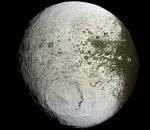 The Strange Tailing Side of Saturns Iapetus
10.10.2007
What has happened to Saturn's moon Iapetus? Vast sections of this strange world are dark as coal, while others are as bright as ice. The composition of the dark material is unknown, but infrared spectra indicate that it possibly contains some dark form of carbon.
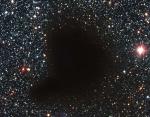 Molecular Cloud Barnard 68
23.09.2001
Where did all the stars go? What used to be considered a hole in the sky is now known to astronomers as a dark molecular cloud. Here, a high concentration of dust and molecular gas absorb practically all the visible light emitted from background stars.
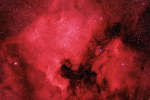 The North America and Pelican Nebulae
30.06.2009
Here are some familiar shapes in unfamiliar locations. This emission nebula on the left is famous partly because it resembles Earth's continent of North America. To the right of the North America Nebula, cataloged as NGC 7000, is a less luminous nebula that resembles a pelican dubbed the Pelican Nebula.
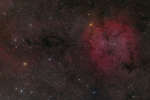 IC 1396 and Surrounding Starfield
19.08.2009
Sprawling across hundreds of light-years, emission nebula IC 1396, visible on the upper right, mixes glowing cosmic gas and dark dust clouds. Stars are forming in this area, only about 3,000 light-years from Earth. This wide angle view also captures surrounding emission and absorption nebula.
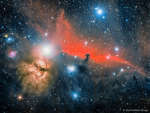 The Horsehead Nebula
6.10.2019
The Horsehead Nebula is one of the most famous nebulae on the sky. It is visible as the dark indentation to the red emission nebula in the center of the above photograph. The horse-head feature is dark because it is really an opaque dust cloud that lies in front of the bright red emission nebula.
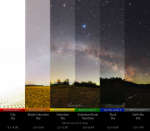 Country Sky versus City Sky
8.04.2020
Dark skies are disappearing from the world. With modernization comes artificial lighting that brightens the night. While these lights allow modern humans to see, much light is wasted up into the sky. This light...
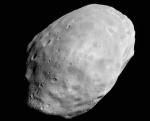 Martian Moon Phobos from MGS
1.07.2003
Why is Phobos so dark? Phobos, the largest and innermost of two Martian moons, is the darkest moon in the entire Solar System. Its unusual orbit and color indicate that it may be a captured asteroid composed of a mixture of ice and dark rock.
 A Cloud Shadow Sunrise
27.02.2002
What could cause a ray of dark? Such a ray was caught in spectacular fashion above the Florida Everglades two years ago. The cause is something surprisingly familiar: a shadow. The gold-tinged cloud near the horizon blocks sunlight from reflecting off air behind the cloud, making that column of air appear unusually dark.
|
January February March April May June July August September |
|||||||||||||||||||||||||||||||||||||||||||||||||