
|
You entered: dark
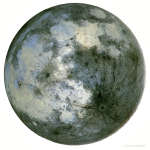 Moon in Inverted Colors
8.03.2022
Which moon is this? It's Earth's moon -- but in inverted colors. Here, the pixel values corresponding to light and dark areas have been translated in reverse, or inverted, producing a false-color representation reminiscent of a black and white photographic negative.
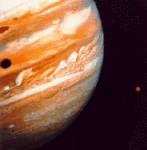 Jupiter, Io, and Ganymede's Shadow
13.10.1995
Jupiter, the solar system's largest planet, is seen here next to Io, its closest Galilean moon. On the cloud tops of Jupiter near the left edge of the picture can be seen a dark circular spot which is caused by the shadow of Jupiter's largest moon Ganymede.
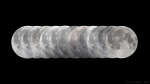 An Almost Eclipse of the Moon
18.01.2020
This composited series of images follows the Moon on January 10, the first Full Moon of 2020, in Hungarian skies. The lunar disk is in mid-eclipse at the center of the sequence though. It looks only slightly darker there as it passes through the light outer shadow or penumbra of planet Earth.
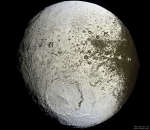 APOD: 2026 July 5 Б Saturns Iapetus: Painted Moon
5.07.2026
What has happened to Saturn's moon Iapetus? Vast sections of this strange world are dark as coal, while others are as bright as snow. To help better understand this unusually tinted moon, in 2007 NASA directed the robotic Cassini spacecraft then orbiting Saturn to swoop within 2,000 kilometers.
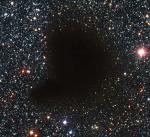 Molecular Cloud Barnard 68
11.05.1999
Where did all the stars go? What used to be considered a hole in the sky is now known to astronomers as a dark molecular cloud. Here, a high concentration of dust and molecular gas absorb practically all the visible light emitted from background stars.
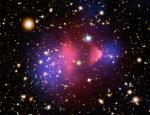 The Matter of the Bullet Cluster
24.08.2006
The matter in galaxy cluster 1E 0657-56, fondly known as the "bullet cluster", is shown in this composite image. A mere 3.4 billion light-years away, the bullet cluster's individual galaxies are seen...
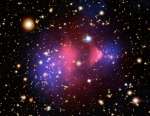 The Matter of the Bullet Cluster
23.08.2008
The matter in galaxy cluster 1E 0657-56, fondly known as the "bullet cluster", is shown in this composite image. A mere 3.4 billion light-years away, the bullet cluster's individual galaxies are seen...
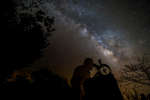 Along the Milky Way
3.07.2021
You can't walk along the Milky Way. Still, under a dark sky you can explore it. To the eye the pale luminous trail of light arcing through the sky on a dark, moonless night does appear to be a path through the heavens.
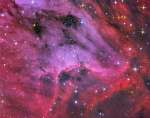 Pelican Nebula Close Up
19.08.2010
The prominent ridge of emission featured in this intensely colorful skyscape is designated IC 5067. Part of a larger emission nebula with a distinctive shape, popularly called The Pelican Nebula, the ridge spans about 10 light-years and follows the curve of the cosmic pelican's head and neck.
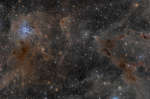 The Iris Nebula in a Field of Dust
12.09.2019
These cosmic dust clouds drift some 1,300 light-years away along the fertile starfields of the constellation Cepheus. The beautiful Iris Nebula, also known as NGC 7023, blossoms at the upper left. Not the only nebula in the sky to evoke the imagery of flowers, its pretty, symmetric form spans about 6 light-years.
|
January February March April May June July August September |
|||||||||||||||||||||||||||||||||||||||||||||||||