
|
You entered: dark
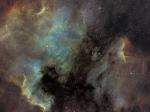 The North America and Pelican Nebulas
16.08.2006
Here are some familiar shapes in unfamiliar locations. This emission nebula on the left is famous partly because it resembles Earth's continent of North America. To the right of the North America Nebula, cataloged as NGC 7000, is a less luminous nebula that resembles a pelican dubbed the Pelican Nebula.
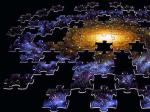 Will the Universe End in a Big Rip
21.10.2007
How will our universe end? Recent speculation now includes a pervasive growing field of mysterious repulsive phantom energy that rips virtually everything apart. Although the universe started with a Big Bang, analysis of cosmological measurements allows a possibility that it will end with a Big Rip.
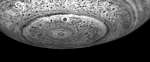 Beneath the South Pole of Saturn
27.10.2008
What clouds lurk beneath Saturn's unusual South Pole? To help find out, the robotic Cassini spacecraft currently orbiting Saturn imaged the nether region of the gigantic ringed orb in infrared light. There thick...
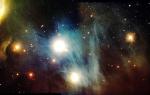 A Chamaeleon Sky
23.03.1999
A photogenic group of nebulae can be found in Chamaeleon, a constellation visible predominantly in skies south of the Earth's equator. Towards Chamaeleon, dark molecular clouds and bright planetary nebula NGC 3195 can be found. Visible near the center of the above photograph is a reflection nebula surrounding a young bright star.
 M83: A Barred Spiral Galaxy
26.09.1999
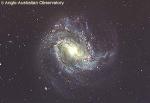
M83 is a bright spiral galaxy that can be found with a small telescope in the constellation of Hydra. It takes light about 15 million years to reach us from M83. M83 is quite a typical spiral - much like our own Milky Way Galaxy.
 The Milky Trail
1.06.2013
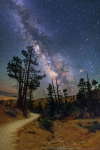
Have you ever hiked the Queen's Garden trail in Bryce Canyon, Utah, USA, planet Earth? Walking along that path in this dark night skyscape, you can almost imagine your journey continues along the pale, luminous Milky Way.
 Full Moondark
12.12.2003
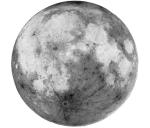
The brilliant full Moon might not have looked quite like this to skygazers this week, but the image is a mosaic of 18 digital frames recorded on December 9th at 3:30 UT.
 The North America and Pelican Nebulas
14.06.2016
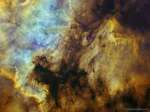
Here lie familiar shapes in unfamiliar locations. On the left is an emission nebula cataloged as NGC 7000, famous partly because it resembles our fair planet's continent of North America. The emission region to the right of the North America Nebula is IC 5070, also known for its suggestive outlines as the Pelican Nebula.
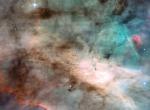 In the Center of the Omega Nebula
8.02.2004
In the depths of the dark clouds of dust and molecular gas known as the Omega Nebula, stars continue to form. The above image from the Hubble Space Telescope's Advanced Camera for Surveys shows exquisite detail in the famous star-forming region.
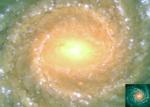 Spiral Galaxy NGC 1232
30.09.1998
Galaxies are fascinating not only for what is visible, but for what is invisible. Grand spiral galaxy NGC 1232, recently captured in detail by the new Very Large Telescope, is a good example.
|
January February March April May June July August September |
|||||||||||||||||||||||||||||||||||||||||||||||||