
|
You entered: dark
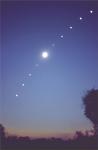 A Total Eclipse Over Africa
11.07.2001
What's that dark spot on the Sun? It's the Moon. Last month, on June 21, a total solar eclipse was visible in parts of Africa. In one of the most spectacular records of this eclipse, Cees Bassa captured the setting Sun being eclipsed in a series of multiple exposures from Malambanyama, Zambia.
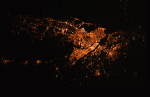 New York at Night
19.11.1995
This tantalizingly clear photo of New York City at night was taken by the astronauts during the Space Radar Laboratory mission of the Space Shuttle Endeavor in March of 1990. In this view, oriented with East up and North to the left, a dense constellation of lights defines the major metropolitan areas.
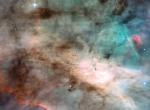 In the Center of the Omega Nebula
1.05.2002
In the depths of the dark clouds of dust and molecular gas known as the Omega Nebula, stars continue to form. The above image from the Hubble Space Telescope's newly installed Advanced Camera for Surveys shows unprecedented detail in the famous star-forming region.
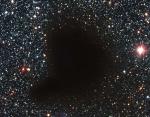 Molecular Cloud Barnard 68
2.02.2003
Where did all the stars go? What used to be considered a hole in the sky is now known to astronomers as a dark molecular cloud. Here, a high concentration of dust and molecular gas absorb practically all the visible light emitted from background stars.
 X-Ray Moon
4.10.2003
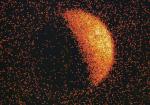
This x-ray image of the Moon was made by the orbiting ROSAT (Röntgensatellit) Observatory in 1990. In this digital picture, pixel brightness corresponds to x-ray intensity. Consider the image in three parts: the bright hemisphere of the x-ray moon, the darker half of the moon, and the x-ray sky background.
 The Milky Road
20.10.2007
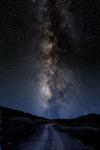
Inspired during a visit to Fort Davis, Texas, home of McDonald Observatory and dark night skies, photographer Larry Landolfi created this tantalizing fantasy view. The composited image suggests the Milky Way is a heavenly extension of a deserted country road.
 APOD: 2026 September 16 Б Webb's View of M64
16.09.2026
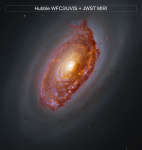
Sometimes where Hubble finds darkness, Webb sees light. An example is todayБs composite images of Messier 64 (M64), a nearby spiral galaxy of many names. The dark band of dust partially blocking its bright core earned it the moniker Бthe Black Eye Galaxy.
 A Force from Empty Space: The Casimir Effect
17.09.2002
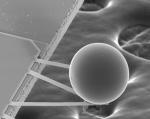
This tiny ball provides evidence that the universe will expand forever. Measuring slightly over one tenth of a millimeter, the ball moves toward a smooth plate in response to energy fluctuations in the vacuum of empty space.
 Horsehead and Orion Nebulas
18.03.2019
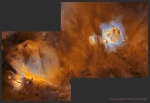
The dark Horsehead Nebula and the glowing Orion Nebula are contrasting cosmic vistas. Adrift 1,500 light-years away in one of the night sky's most recognizable constellations, they appear in opposite corners of the above stunning two-panel mosaic.
 The Road and the Milky Way
11.06.2022
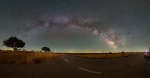
At night you can follow this road as it passes through the Dark Sky Alqueva reserve not too far from Alentejo, Portugal. Or you could stop, look up, and follow the Milky Way through the sky. Both stretch from horizon to horizon in this 180 degree panorama recorded on June 3.
|
January February March April May June July August September |
|||||||||||||||||||||||||||||||||||||||||||||||||