
|
You entered: gas
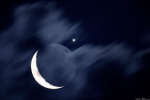 Moon Meets Jupiter
10.07.2016
What's that next to the Moon? Jupiter -- and its four largest moons. Skygazers around planet Earth enjoyed the close encounter of planets and Moon in 2012 July 15's predawn skies. And while...
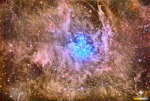 The Pleiades Deep and Dusty
14.11.2017
The well-known Pleiades star cluster is slowly destroying part of a passing cloud of gas and dust. The Pleiades is the brightest open cluster of stars on Earth's sky and can be seen from almost any northerly location with the unaided eye.
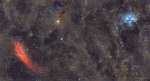 Seven Sisters versus California
5.04.2022
On the upper right, dressed in blue, is the Pleiades. Also known as the Seven Sisters and M45, the Pleiades is one of the brightest and most easily visible open clusters on the sky. The Pleiades contains over 3,000 stars, is about 400 light years away, and only 13 light years across.
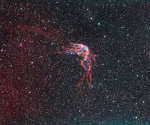 RCW 86: Historical Supernova Remnant
28.05.2022
In 185 AD, Chinese astronomers recorded the appearance of a new star in the Nanmen asterism. That part of the sky is identified with Alpha and Beta Centauri on modern star charts. The new star was visible for months and is thought to be the earliest recorded supernova.
 APOD: 2026 April 13 Б NGC 602 and Beyond
13.04.2026
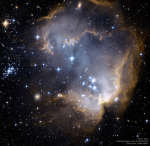
The clouds may look like an oyster, and the stars like pearls, but look beyond. Near the outskirts of the Small Magellanic Cloud, a satellite galaxy some 200 thousand light-years distant, lies 5 million year young star cluster NGC 602.
 September Sky
29.09.2000
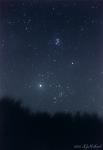
Star clusters, planets, and a red giant posed for this portrait of the night sky from rural Jasper County, Iowa, USA. Astrophotographer Stan Richard recorded the four minute time exposure looking east around midnight on September 3rd at Ashton-Wildwood Park.
 M57: The Ring Nebula
27.07.1995
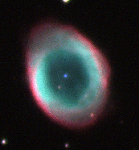
A star with mass similar to that of our Sun will throw off its outer gasses after fusion has stopped in its core. Possibly the most visually spectacular of these planetary nebula is the pictured Ring Nebula. The appearance as a ring is really an illusion of projection - the nebula is actually a spherical shell.
 X-Rays from the Galactic Core
6.11.2004
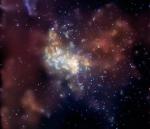
Using the orbiting Chandra X-ray Observatory, astronomers have taken this long look at the core of our Milky Way galaxy, some 26,000 light-years away. The spectacular false-color view spans about 130 light-years.
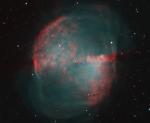 M27: Not A Comet
3.08.2006
While searching the skies above 18th century France for comets, astronomer Charles Messier diligently recorded this object as number 27 on his list of things which are definitely not comets. So what is it?
 Dark Markings of the Sky
25.04.2009
Based on wide field photographs, American astronomer Edward Emerson Barnard cataloged the dark markings of the sky in the early 20th century. Barnard's markings are dark nebulae, interstellar clouds of obscuring gas and dust.
|
January February March April May June July August September October |
|||||||||||||||||||||||||||||||||||||||||||||||||