
|
You entered: gas
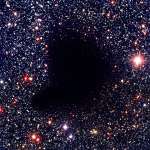 Molecular Cloud Barnard 68
23.06.2009
Where did all the stars go? What used to be considered a hole in the sky is now known to astronomers as a dark molecular cloud. Here, a high concentration of dust and molecular gas absorb practically all the visible light emitted from background stars.
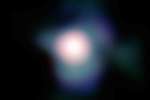 Betelgeuse Resolved
5.08.2009
The sharpest image ever of Betelgeuse shows a mammoth star that is slowly evaporating. Betelgeuse (sounds a lot like "beetle juice"), also known as Alpha Orionis, is one of the largest and brightest stars known. The star is a familiar orange fixture easily visible to the unaided eye toward the constellation of Orion.
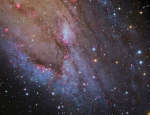 NGC 206 and the Star Clouds of Andromeda
25.09.2014
The large stellar association cataloged as NGC 206 is nestled within the dusty arms of the neighboring Andromeda galaxy. Also known as M31, the spiral galaxy is a mere 2.5 million light-years away.
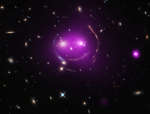 Gravity s Grin
27.11.2015
Albert Einstein's general theory of relativity, published 100 years ago this month, predicted the phenomenon of gravitational lensing. And that's what gives these distant galaxies such a whimsical appearance, seen through the looking glass of X-ray and optical image data from the Chandra and Hubble space telescopes.
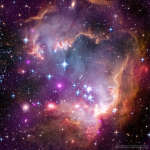 NGC 602 and Beyond
2.04.2017
Near the outskirts of the Small Magellanic Cloud, a satellite galaxy some 200 thousand light-years distant, lies 5 million year young star cluster NGC 602. Surrounded by natal gas and dust...
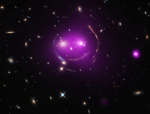 Gravity s Grin
5.08.2017
Albert Einstein's general theory of relativity, published over 100 years ago, predicted the phenomenon of gravitational lensing. And that's what gives these distant galaxies such a whimsical appearance, seen through the looking glass of X-ray and optical image data from the Chandra and Hubble space telescopes.
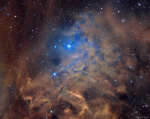 AE Aurigae and the Flaming Star Nebula
25.02.2018
Why is AE Aurigae called the flaming star? For one reason, the surrounding nebula IC 405 is named the Flaming Star Nebula because the region seems to harbor smoke, even though nothing is on fire, including interior star AE Aurigae.
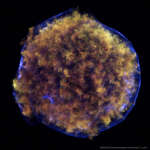 Tychos Supernova Remnant in Xray
13.01.2019
What star created this huge puffball? What's pictured is the hot expanding nebula of Tycho's supernova remnant, the result of a stellar explosion first recorded over 400 years ago by the famous astronomer Tycho Brahe. The featured image is a composite of three X-ray colors taken by the orbiting Chandra X-ray Observatory.
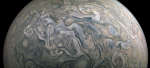 Churning Clouds on Jupiter
11.08.2020
Where is Jupiter's ammonia? Gaseous ammonia was expected to be seen in Jupiter's upper atmosphere by the orbiting Juno spacecraft -- but in many clouds is almost absent. Recent Juno data, however, gives some clues: some high-level clouds appear to be home to an unexpected type of electrical discharge dubbed shallow lightning.
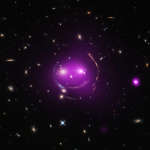 Gravity s Grin
11.05.2022
Albert Einstein's general theory of relativity, published over 100 years ago, predicted the phenomenon of gravitational lensing. And that's what gives these distant galaxies such a whimsical appearance, seen through the looking glass of X-ray and optical image data from the Chandra and Hubble space telescopes.
|
January February March April May June July August September October |
|||||||||||||||||||||||||||||||||||||||||||||||||