
|
You entered: gas
 APOD: 2023 May 16 Б Total Eclipse: The Big Corona
16.05.2023
Most photographs don't adequately portray the magnificence of the Sun's corona. Seeing the corona first-hand during a total solar eclipse is unparalleled. The human eye can adapt to see coronal features and extent that average cameras usually cannot. Welcome, however, to the digital age.
 APOD: 2024 August 28 Б Tulip Nebula and Black Hole Cygnus X 1
28.08.2024
When can you see a black hole, a tulip, and a swan all at once? At night -- if the timing is right, and if your telescope is pointed in the right direction. The complex and beautiful Tulip Nebula blossoms about 8,000 light-years away toward the constellation of Cygnus the Swan.
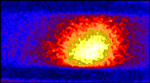 An Extreme UltraViolet View of the Comet
30.03.1996
As the Sun floods Comet Hyakutake with ultraviolet light gases in the coma scatter the radiation and fluoresce making the comet a bright source in the ultraviolet sky. The above image made using data...
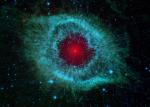 APOD: 2007 February 23- Dust and the Helix Nebula
23.02.2007
Dust makes this cosmic eye look red. The eerie Spitzer Space Telescope image shows infrared radiation from the well-studied Helix Nebula (NGC 7293) a mere 700 light-years away in the constellation Aquarius.
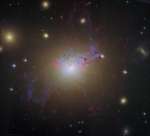 Hubble Remix: Active Galaxy NGC 1275
4.06.2010
Active galaxy NGC 1275 is the central, dominant member of the large and relatively nearby Perseus Cluster of Galaxies. Wild-looking at visible wavelengths, the active galaxy is also a prodigious source of x-rays and radio emission.
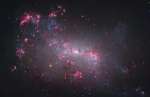 NGC 4449: Close up of a Small Galaxy
25.02.2011
Grand spiral galaxies often seem to get all the glory. Their young, blue star clusters and pink star forming regions along sweeping spiral arms are guaranteed to attract attention. But small irregular galaxies form stars too, like NGC 4449, about 12 million light-years distant.
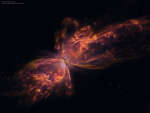 The Butterfly Nebula from Hubble
8.02.2017
The bright clusters and nebulae of planet Earth's night sky are often named for flowers or insects. Though its wingspan covers over 3 light-years, NGC 6302 is no exception. With an estimated surface...
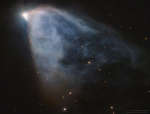 NGC 2261: Hubble s Variable Nebula
8.11.2017
What causes Hubble's Variable Nebula to vary? The unusual nebula featured here changes its appearance noticeably in just a few weeks. Discovered over 200 years ago and subsequently cataloged as NGC 2661, the remarkable nebula is named for Edwin Hubble, who studied it early last century.
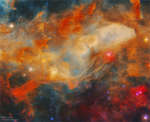 The Blue Horsehead Nebula in Infrared
23.04.2018
The Blue Horsehead Nebula looks quite different in infrared light. In visible light, the reflecting dust of the nebula appears blue and shaped like a horse's head. In infrared light, however, a complex labyrinth of filaments, caverns, and cocoons of glowing dust and gas emerges, making it hard to even identify the equine icon.
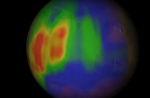 Mars Methane Mystery Deepens
22.04.2019
The methane mystery on Mars just got stranger. New results from ESA and Roscosmos' ExoMars Trace Gas Orbiter, has unexpectedly not detected methane in the atmosphere of Mars. This result follows the 2013 detection of methane by NASA's Curiosity rover, a result seemingly confirmed by ESA's orbiting Mars Express the next day.
|
January February March April May June July August September October |
|||||||||||||||||||||||||||||||||||||||||||||||||