
|
You entered: gas
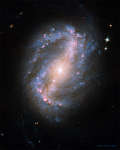 Barred Spiral Galaxy NGC 6217
21.02.2022
Many spiral galaxies have bars across their centers. Even our own Milky Way Galaxy is thought to have a modest central bar. Prominently barred spiral galaxy NGC 6217, featured here, was captured in spectacular detail in this image taken by the Advanced Camera for Surveys on the orbiting Hubble Space Telescope in 2009.
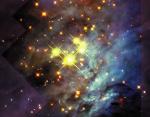 The Brown Dwarfs of Orions Trapezium
30.08.2000
The bright stars above are well known as heart of the Trapezium, an open cluster of stars in the center of the Orion Nebula. The many dim objects, however, are not well known, and have come to attention only on recent images in infrared light.
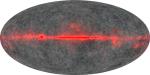 Universe Age from the Microwave Background
17.02.2003
The above sky map tells us the universe is 13.7 billion years old -- but how? At first look, one only sees the microwave glow of gas from our Milky Way Galaxy, coded red, and a spotty pattern of microwaves emitted from the early universe, coded in gray.
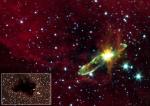 Young Star, Dark Cloud
26.12.2003
High-speed outflows of molecular gas from a young stellar object glow in infrared light, revealing themselves in this recent false-color image from the Spitzer Space Telescope. Cataloged as HH (Herbig-Haro) 46/47 the infrared source...
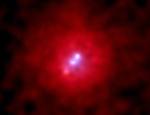 3C 295: X-rays From A Giant Galaxy
25.11.1999
Did this galaxy eat too much? Five billion light-years away, the giant elliptical galaxy 3C295 is a prodigious source of energy at radio wavelengths. Bright knots of X-ray emission are also seen at the center of this false-color Chandra Observatory image of the region.
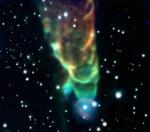 Cosmic Tornado HH 49 50
11.08.2007
Light-years in length, this cosmic tornado is actually a powerful jet cataloged as HH (Herbig-Haro) 49/50 blasting down from the top of a Spitzer Space Telescope view. Though such energetic outflows are well known...
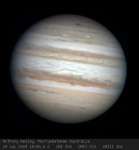 Jupiter s Impact Scar
23.07.2009
In July of 1994 pieces of Comet Shoemaker-Levy 9 collided with planet Jupiter. The explosive impacts sent plumes of debris high into the Jovian atmosphere creating dark markings or scars, visible for a time against the cloud bands.
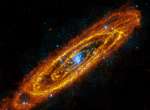 The Once and Future Stars of Andromeda
20.01.2011
The big, beautiful Andromeda Galaxy, aka M31, is a spiral galaxy a mere 2.5 million light-years away. Two space-based observatories have combined to produce this intriguing composite image of Andromeda, at wavelengths outside the visible spectrum. The remarkable view follows the locations of this galaxy's once and future stars.
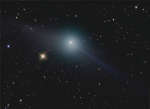 The Opposing Tails of Comet Garradd
28.02.2012
Why does Comet Garradd have two tails? Visible on the left, Comet Garradd's dust tail is composed of ice and dust bits that trial the comet in its orbit around the Sun. Visible...
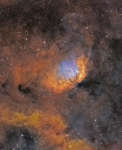 The Tulip in the Swan
14.11.2014
Framing a bright emission region this telescopic view looks out along the plane of our Milky Way Galaxy toward the nebula rich constellation Cygnus the Swan. Popularly called the Tulip Nebula the glowing cloud of interstellar gas and dust is also found in the 1959 catalog by astronomer Stewart Sharpless as Sh2-101.
|
January February March April May June July August September October |
|||||||||||||||||||||||||||||||||||||||||||||||||