
|
You entered: Earth
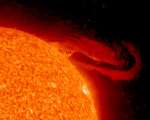 A Solar Prominence Unfurls
4.10.2008
On September 29, this magnificent eruptive solar prominence lifted away from the Sun's surface, unfurling into space over the course of several hours. Suspended in twisted magnetic fields, the hot plasma structure is many times the size of planet Earth and was captured in this view by the Sun-watching STEREO (Ahead) spacecraft.
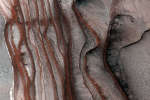 Layers of Cliffs in Northern Mars
6.10.2008
How did these layers of red cliffs form on Mars? No one is sure. The northern ice cap on Mars is nearly divided into two by a huge division named Chasma Boreale. No similar formation occurs on Earth. Pictured above, several dusty layers leading into this deep chasm are visible.
 Damage to Apollo 13
17.04.2010
After an oxygen tank exploded and crippled their service module, the Apollo 13 astronauts were forced to abandon plans to make the third manned lunar landing. The extent of the damage is revealed...
 Daytime Moon Meets Morning Star
27.02.2014
Venus now appears as planet Earth's brilliant morning star standing above the eastern horizon before dawn. For most, the silvery celestial beacon rose in a close pairing with an old crescent Moon on February 26.
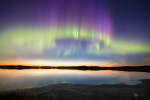 Northern Lights and Noctilucent Clouds
20.06.2018
Skies after the near-solstice sunset on June 17 are reflected in this calm lake. The tranquil twilight scene was captured near Bashaw, Alberta, Canada, northern planet Earth. Usually spotted at high latitudes in summer months, night shining or noctilucent clouds hang just above the horizon, transfusing light into a darker sky.
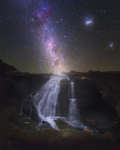 Milky Way Falls
11.01.2019
It can be the driest place on planet Earth, but water still flows in Chile's Atacama desert, high in the mountains. After discovering this small creek with running water, the photographer returned...
 M51: The Whirlpool Galaxy from Hubble
12.06.2022
The Whirlpool Galaxy is a classic spiral galaxy. At only 30 million light years distant and fully 60 thousand light years across, M51, also known as NGC 5194, is one of the brightest and most picturesque galaxies on the sky.
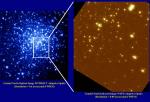 NGC 6934 from Gemini North
30.06.1999
What's going on near the center of globular cluster NGC 6934? The blur caused by the Earth's atmosphere has prevented astronomers from discerning individual stars in this unusual environment. Telescopes in space can help, but the new Gemini North telescope took the above picture from the ground.
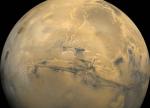 Valles Marineris: The Grand Canyon of Mars
27.08.2002
The largest canyon in the Solar System cuts a wide swath across the face of Mars. Named Valles Marineris, the grand valley extends over 3,000 kilometers long, spans as much as 600 kilometers across, and delves as much as 8 kilometers deep.
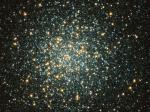 Globular Cluster M3 from WIYN
11.03.2006
This huge ball of stars predates our Sun. Long before humankind evolved, before dinosaurs roamed, and even before our Earth existed, ancient globs of stars condensed and orbited a young Milky Way Galaxy.
|
January February March April May June July August September October |
|||||||||||||||||||||||||||||||||||||||||||||||||