
|
You entered: Earth
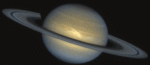 A Storm on Saturn
18.10.1995
The white wisp shown on Saturn's cloud tops is actually a major storm system only discovered in December of 1994. Saturn's clouds are composed of primarily hydrogen and helium, but the storm's white clouds are actually ammonia ice crystals that have frozen upon upheaval to the top of the atmosphere.
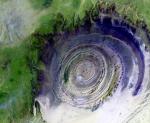 Earths Richat Structure
28.10.2002
What on Earth is that? The Richat Structure in the Sahara Desert of Mauritania is easily visible from space because it is nearly 50 kilometers across. Once thought to be an impact crater, the Richat Structure's flat middle and lack of shock-altered rock indicates otherwise.
 The Leonid Meteor Shower (Tonight)
16.11.1996
Tonight thousands of icy rocks will hurl toward Earth in a fascinating display of light called the Leonid Meteor Shower. There is little danger - few will reach the ground. But this year's Leonids could be nothing compared to the Leonids in 1998.
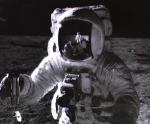 Apollo 12: Self-Portrait
9.05.1997
Is it art? In November of 1969, Apollo 12 astronaut-photographer Charles "Pete" Conrad recorded this masterpiece while documenting colleague Alan Bean's lunar soil collection activities on the Oceanus Procellarum. The image is dramatic and stark.
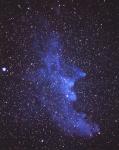 The Witch Head Nebula
9.02.1998
Double, double toil and trouble; Fire burn, and cauldron bubble ... Maybe Macbeth should have consulted the Witch Head Nebula. This suggestively shaped reflection nebula is associated with the bright star Rigel in the constellation Orion. More formally known as IC 2118, the Witch Head Nebula glows primarily by light reflected from Rigel.
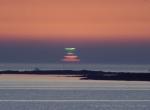 A Green Flash from the Sun
21.03.2004
Many think it is just a myth. Others think it is true but its cause isn't known. Adventurers pride themselves on having seen it. It's a green flash from the Sun. The truth is the green flash does exist and its cause is well understood.
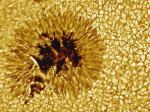 A Sunspot Up Close
6.11.2005
Why would a small part of the Sun appear slightly dark? Visible above is a close-up picture of a sunspot, a depression on the Sun's face that is slightly cooler and less luminous than the rest of the Sun.
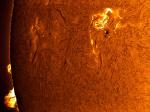 Sunspot 875 Flares
2.05.2006
An unusually active sunspot region is now crossing the Sun. The region, numbered 875, is larger than the Earth and has produced several solar flares over the past week. It should take a few more days for Sunspot 875 to finish crossing the solar disk.
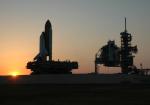 Discovery in Motion
8.07.2006
On July 4th, the space shuttle orbiter Discovery rocketed into space on mission STS-121. Now docked with the International Space Station, Discovery orbits planet Earth at about 27 thousand kilometers per hour.
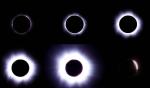 Light From The Dark Sun
19.08.1999
Only in the fleeting darkness of a total solar eclipse is the light of the solar corona easily visible from Earth. Normally overwhelmed by the bright solar disk, the expansive corona, the sun's outer atmosphere, is an alluring sight.
|
January February March April May June July August September October |
|||||||||||||||||||||||||||||||||||||||||||||||||