
|
You entered: Earth
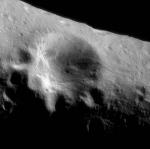 Nearer To Asteroid Eros
7.03.2000
As the robot spacecraft NEAR lowers itself toward asteroid 433 Eros, more surface details are becoming visible. Last week's maneuvers brought NEAR to within 204 kilometers of the floating mountain's surface. With...
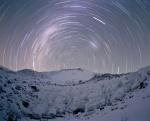 Star Trails at 19 000 Feet
1.12.2006
In myth, Atlas holds up the heavens, but in this stunning view a mountain appears to serve as the southern night sky pivots around a snowy peak. Recorded during a climbing expedition...
 A Wide Field Image of the Galactic Center
6.01.2012
From Sagittarius to Scorpius, the central Milky Way is a truly beautiful part of planet Earth's night sky. The gorgeous region is captured in this wide field image spanning about 30 degrees.
 Take a Picture of Saturn
19.07.2013
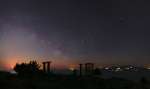
Take a picture of Saturn in the sky tonight. You could capture a view like this one. Recorded just last month looking toward the south, planet Earth and ruins of the ancient temple of Athena at Assos, Turkey are in the foreground.
 Space Shuttle and Space Station Photographed Together
31.08.2014
How was this picture taken? Usually, pictures of the shuttle, taken from space, are snapped from the space station. Commonly, pictures of the space station are snapped from the shuttle. How, then, can there be a picture of both the shuttle and the station together, taken from space?
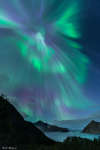 Auroral Corona over Norway
14.10.2014
Higher than the highest mountain lies the realm of the aurora. Auroras rarely reach below 60 kilometers, and can range up to 1000 kilometers. Aurora light results from energetic electrons and protons striking atoms and molecules in the Earth's atmosphere.
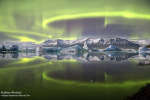 Aurora over Icelandic Glacier
9.03.2015
Several key conditions came together to create this award-winning shot. These included a dark night, few clouds, an epic auroral display, and a body of water that was both calm enough and unfrozen enough to show reflected stars.
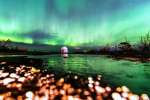 Aurora: The Frog's View
5.10.2018
What does an aurora look like to a frog? "Awesome!" is the likely answer, suggested by this imaginative snapshot taken on October 3rd from Kiruna, Sweden. Frequented by apparitions of the northern lights, Kiruna...
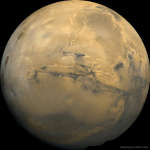 Valles Marineris: The Grand Canyon of Mars
23.05.2020
The largest canyon in the Solar System cuts a wide swath across the face of Mars. Named Valles Marineris, the grand valley extends over 3,000 kilometers long, spans as much as 600 kilometers across, and delves as much as 8 kilometers deep.
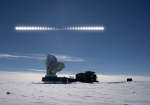 Postcard from the South Pole
10.12.2021
From this vantage point about three quarters of a mile from planet Earth's geographic South Pole, the December 4 eclipse of the Sun was seen as a partial eclipse. At maximum eclipse the New Moon blocked 90 percent of the solar disk.
|
January February March April May June July August September October |
|||||||||||||||||||||||||||||||||||||||||||||||||