
|
You entered: Earth
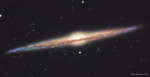 NGC 4565: Galaxy on Edge
26.05.2022
Magnificent spiral galaxy NGC 4565 is viewed edge-on from planet Earth. Also known as the Needle Galaxy for its narrow profile, bright NGC 4565 is a stop on many telescopic tours of the northern sky, in the faint but well-groomed constellation Coma Berenices.
 NGC 4565: Galaxy on Edge
6.06.2024
Magnificent spiral galaxy NGC 4565 is viewed edge-on from planet Earth. Also known as the Needle Galaxy for its narrow profile, bright NGC 4565 is a stop on many telescopic tours of the northern sky, in the faint but well-groomed constellation Coma Berenices.
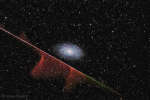 APOD: 2024 July 14 Б Meteor Misses Galaxy
14.07.2024
The galaxy was never in danger. For one thing, the Triangulum galaxy (M33), pictured, is much bigger than the tiny grain of rock at the head of the meteor. For another, the galaxy is much farther away -- in this instance 3 million light years as opposed to only about 0.0003 light seconds.
 Solar Analemma 2024
2.01.2025
Recorded during 2024, this year-spanning series of images reveals a pattern in the seasonal drift of the Sun's daily motion through planet Earth's sky. Known to some as an analemma, the figure-eight curve was captured in exposures taken only at 1pm local time on clear days from Kayseri, Turkiye.
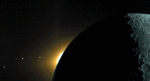 The Ecliptic Plane
21.09.1996
The Plane of the Ecliptic is illustrated in this Clementine star tracker camera image which reveals (from right to left) the Moon lit by Earthshine, the Sun's corona rising over the Moon's dark limb, and the planets Saturn, Mars, and Mercury.
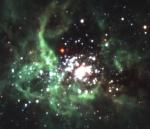 Tarantula
4.06.1997
NGC 2070 is an immense star forming region in a nearby galaxy known as the Large Magellanic Cloud. Its spidery appearance is responsible for its popular name, "The Tarantula Nebula", except that this tarantula is about 1,000 light-years across, and 165,000 light-years away in the southern constellation Dorado.
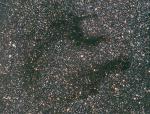 The E Nebula in Aquila
20.08.2003
Several unusual strands of darkness are prominent toward the constellation of Aquila. This particular dark nebula is known as the E Nebula, for its evocative shape, or B142 and B143, for its position(s) on a list of such nebula compiled by Barnard.
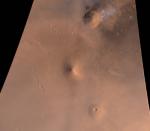 Volcanos on Mars: Elysium Region
30.07.1998
This "synthetic color" image swath of the Elysium Volcanic Region of Mars was recorded by Mars Global Surveyor's wide angle camera on July 2. North is up and the sun illuminates the scene from the lower right. Bright clouds hover near the northern most dome-shaped volcano Hecates Tholus.
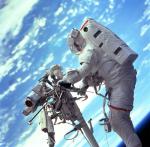 Working in Space
23.05.2004
High above planet Earth, a human helps an ailing machine. The machine, in this potentially touching story, is the Hubble Space Telescope, which is not in the picture. The human is Astronaut Steven L.
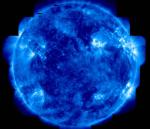 Autumn and the Active Sun
23.09.1998
As the Sun heads South, crossing the celestial equator today at 1:37 a.m. Eastern Time, Autumn begins for Earth's Northern Hemisphere. This Autumnal Equinox finds an increasingly active Sun steadily approaching a solar cycle maximum expected around the year 2003.
|
January February March April May June July August September October |
|||||||||||||||||||||||||||||||||||||||||||||||||