
|
You entered: NASA
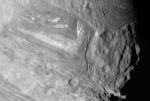 Miranda, Chevron, and Alonso
6.03.1999
Miranda is a bizarre world which surely had a tempestuous past. The innermost of the larger Uranian moons, Miranda is almost 300 miles in diameter and was discovered in 1948 by American planetary astronomer Gerard Kuiper.
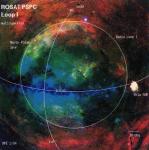 Loop I in the Northern Sky
3.05.1999
One of the largest coherent structures on the sky is known simply as Loop I and can best be seen in radio and X-ray maps. Spanning over 100 degrees, part of Loop I appears so prominent in northern sky maps that it is known as the North Polar Spur (NPS).
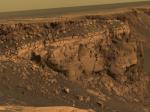 At the Edge of Victoria Crater
3.07.2007
We're going in. The robotic Opportunity rover currently rolling across Mars has been prowling around the edge of the largest crater it has visited since landing over three years ago. It has been studying Victoria crater and looking for a way in.
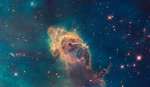 Carina Pillar and Jets
1.10.2009
This cosmic pillar of gas and dust is nearly 2 light-years wide. The structure lies within one of our galaxy's largest star forming regions, the Carina Nebula, shining in southern skies at a distance of about 7,500 light-years.
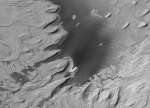 Ancient Layered Hills on Mars
29.11.2009
Is this a picture of Mars or Earth? Oddly enough, it is a picture of Mars. What may appear to some as a terrestrial coastline is in fact a formation of ancient layered hills and wind-blown sand on Mars. The above-pictured region spans about three kilometers in Schiaparelli Crater.
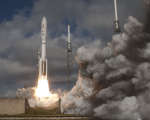 Curiosity Rover Lifts Off for Mars
30.11.2011
Next stop: Mars. This past weekend the Mars Science Laboratory carrying the Curiosity Rover blasted off for the red planet atop an Atlas V rocket from Cape Canaveral, Florida, USA, as pictured above.
 Shocked by Supernova 1987A
27.02.2012
Twenty five years ago, the brightest supernova of modern times was sighted. Over time, astronomers have watched and waited for the expanding debris from this tremendous stellar explosion to crash into previously expelled material.
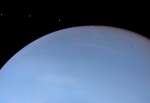 Despina, Moon of Neptune
16.01.2014
Despina is a tiny moon of Neptune. A mere 148 kilometers across, diminutive Despina was discovered in 1989, in images from the Voyager 2 spacecraft taken during its encounter with the solar system's most distant gas giant planet.
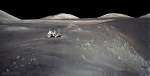 Apollo 17 at Shorty Crater
2.08.2015
On the Moon, it is easy to remember where you parked. In December of 1972, Apollo 17 astronauts Eugene Cernan and Harrison Schmitt spent about 75 hours on the Moon in the Taurus-Littrow valley, while colleague Ronald Evans orbited overhead. This sharp image was taken by Cernan as he and Schmitt roamed the valley floor.
 Earth at Night
9.07.2017
Can you find your favorite country or city? Surprisingly, on this world-wide nightscape, city lights make this task quite possible. Human-made lights highlight particularly developed or populated areas of the Earth's surface, including the seaboards of Europe, the eastern United States, and Japan.
|
January February March April May June July August September October |
|||||||||||||||||||||||||||||||||||||||||||||||||