
|
You entered: NASA
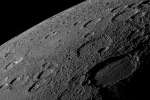 Mercurys Horizon from MESSENGER
21.01.2008
What would it look like to fly past Mercury? Just such an adventure was experienced last week by the MESSENGER spacecraft during its first flyby of the strange moon-like world nearest the Sun. Pictured above is the limb of Mercury seen by MESSENGER upon approach, from about 1 1/2 Earth diameters away.
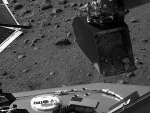 Mars Soil Sample Ready to Analyze
8.06.2008
What surprises are hidden in the soils of Mars? To help find out, the Phoenix Lander Phoenix Lander which arrived on Mars two weeks ago has attempted to place a scoop of soil in Phoenix's Thermal and Evolved-Gas Analyzer (TEGA). Pictured above, the dirt-filled scoop approaches one of TEGA's eight ovens.
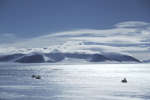 Searching for Meteorites in Antarctica
7.09.2008
Where is the best place on Earth to find meteorites? Although meteors fall all over the world, they usually just sink to the bottom of an ocean, are buried by shifting terrain, or are easily confused with terrestrial rocks.
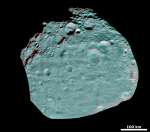 Stereo Vesta
20.08.2011
Get out your red/blue glasses and float next to 4 Vesta. A 500 kilometer diameter world, Vesta lies in the main asteroid belt between the orbits of Mars and Jupiter. This stereo anaglyph...
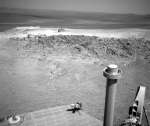 Opportunity Rover Spots Greeley Haven on Mars
25.01.2012
Where on Mars should you spend the winter? As winter approached in the southern hemisphere of Mars last November, the Opportunity rover had just this problem -- it needed a place to go. The reduced...
 Discovery Departs
19.04.2012
Climbing into cloudy skies, the Space Shuttle Orbiter Discovery (OV-103) took off from Kennedy Space Center Tuesday at 7 am local time. This time, its final departure from KSC, it rode atop a modified Boeing 747 Shuttle Carrier Aircraft.
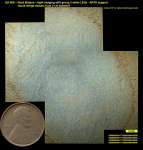 Crystals on Mars
11.12.2014
This extreme close-up, a mosaic from the Mars Hand Lens Imager (MAHLI) on the Curiosity rover, spans a breathtaking 5 centimeters. It captures what appear to be elongated crystal shapes formed by the precipitation of minerals dissolved in water, a likely result of the evaporation of ancient lake or river from the Martian surface.
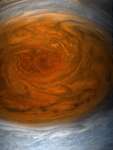 Close up of the Great Red Spot
15.07.2017
On July 11, the Juno spacecraft once again swung near to Jupiter's turbulent cloud tops in its looping 53 day orbit around the Solar System's ruling gas giant. About 11 minutes after perijove 7, its closest approach on this orbit, it passed directly above Jupiter's Great Red Spot.
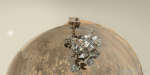 Selfie at Vera Rubin Ridge
26.01.2018
On sol 1943 of its journey of exploration across the surface of Mars, the Curiosity Rover recorded this selfie at the south rim of Vera Rubin Ridge. Of course a sol is a Martian solar day, about 40 minutes longer than an Earth day. Curiosity's sol 1943 corresponds to Earth date January 23, 2018.
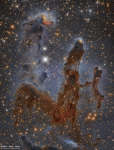 Pillars of the Eagle Nebula in Infrared
20.06.2018
Newborn stars are forming in the Eagle Nebula. Gravitationally contracting in pillars of dense gas and dust, the intense radiation of these newly-formed bright stars is causing surrounding material to boil away. This image...
|
January February March April May June July August September October |
|||||||||||||||||||||||||||||||||||||||||||||||||