
|
You entered: NASA
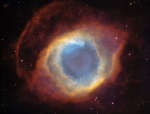 The Helix Nebula from Blanco and Hubble
23.08.2020
How did a star create the Helix nebula? The shapes of planetary nebula like the Helix are important because they likely hold clues to how stars like the Sun end their lives. Observations...
 Capsule Returns from Asteroid Ryugu
14.12.2020
The streak across the sky is a capsule returning from an asteroid. It returned earlier this month from the near-Earth asteroid 162173 Ryugu carrying small rocks and dust from its surface. The canister...
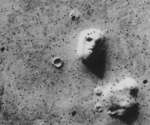 The Face on Mars
4.07.2021
Wouldn't it be fun if clouds were castles? Wouldn't it be fun if the laundry on the bedroom chair was a superhero? Wouldn't it be fun if rock mesas on Mars were interplanetary monuments to the human face? Clouds, though, are floating droplets of water and ice.
 Rubin's Galaxy
18.09.2021
In this Hubble Space Telescope image the bright, spiky stars lie in the foreground toward the heroic northern constellation Perseus and well within our own Milky Way galaxy. In sharp focus beyond is UGC 2885, a giant spiral galaxy about 232 million light-years distant.
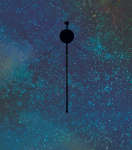 Interstellar Voyager
9.09.2022
Voyager 1 and Voyager 2 were launched in 1977 on a grand tour of the outer planets of the Solar System. They have become the longest operating and most distant spacecraft from Earth. Both have traveled beyond the heliosphere, the realm defined by the influence of the solar wind and the Sun's magnetic field.
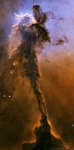 The Fairy of Eagle Nebula
25.09.2022
The dust sculptures of the Eagle Nebula are evaporating. As powerful starlight whittles away these cool cosmic mountains, the statuesque pillars that remain might be imagined as mythical beasts. Featured here is one of several striking dust pillars of the Eagle Nebula that might be described as a gigantic alien fairy.
 Rubin s Galaxy
5.04.2023
In this Hubble Space Telescope image the bright, spiky stars lie in the foreground toward the heroic northern constellation Perseus and well within our own Milky Way galaxy. In sharp focus beyond is UGC 2885, a giant spiral galaxy about 232 million light-years distant.
 APOD: 2024 February 11 Б Rocket Plume Shadow Points to the Moon
11.02.2024
Why would the shadow of a rocket's launch plume point toward the Moon? In early 2001 during a launch of the space shuttle Atlantis, the Sun, Earth, Moon, and rocket were all properly aligned for this photogenic coincidence.
 APOD: 2024 September 2 Б A Triangular Prominence Hovers Over the Sun
2.09.2024
Why is there a triangle hovering over the Sun? Although the shape is unusual, the type of structure is not: it is part of an evolving solar prominence. Looping magnetic fields on the Sun channel the flow of energetic particles, sometimes holding glowing gaseous structures aloft for months.
 Athena to the Moon
28.02.2025
Planet Earth hangs in the background of this space age selfie. The snapshot was captured by the IM-2 Nova-C lander Athena, just after stage separation following its February 26 launch to the Moon.
|
January February March April May June July August September October |
|||||||||||||||||||||||||||||||||||||||||||||||||