
|
You entered: NASA
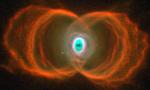 MyCn18: An Hourglass Nebula
14.09.1997
The sands of time are running out for the central star of this hourglass-shaped planetary nebula. With its nuclear fuel exhausted, this brief, spectacular, closing phase of a Sun-like star's life occurs as its outer layers are ejected - its core becoming a cooling, fading white dwarf.
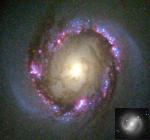 NGC 4314: A Nuclear Starburst Ring
15.06.1998
Is this old galaxy up to new tricks? The barred spiral galaxy NGC 4314 is billions of years old, but its appearance has changed markedly over just the past few millions of years. During that time, a nuclear ring of bright young stars has been evolving.
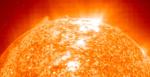 A Great Day For SOHO
15.10.1998
The last 10 days have been great days for SOHO, the space-based SOlar and Heliospheric Observatory. Contact was completely lost with this international research spacecraft over 3 months ago but recovery teams have reacquired control of SOHO and, beginning October 5th, have been successfully switching on its scientific instruments.
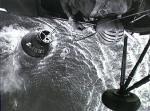 Liberty Bell 7
6.05.1999
Today, the space capsule Liberty Bell 7 rests about 3 miles below the surface of the Atlantic Ocean. But on July 21, 1961, astronaut Virgil I. "Gus" Grissom rode this tiny craft 118 miles above the Earth to become the second American in space.
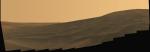 New Year Mars Panorama
4.01.2006
According to an Earth-based calendar, the Spirit rover spent the first day of 2006 gathering data to complete this panoramic view from Gusev crater on Mars. That day corresponded to Spirit's 710th Martian day or sol on the Red Planet.
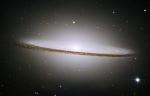 The Sombrero Galaxy from HST
14.01.2006
Why does the Sombrero Galaxy look like a hat? Reasons include the Sombrero's unusually large and extended central bulge of stars, and dark prominent dust lanes that appear in a disk that we see nearly edge-on. Billions of old stars cause the diffuse glow of the extended central bulge.
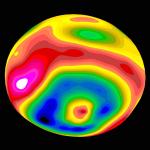 A Map of Asteroid Vesta
20.08.2006
Vesta is a huge rock 500 kilometers across that orbits out past Mars. In 1997, the above map of Vesta created using the Hubble Space Telescope was released showing a rugged surface highlighted by a single crater spanning nearly the entire length of the asteroid.
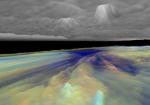 3D View Of Jupiter's Clouds
29.04.2000
Every day is a cloudy day on Jupiter, the Solar System's reigning gas giant. This 3-dimensional visualization presents a simplified model view from between Jovian cloud decks based on imaging and spectral data recorded by the Galileo spacecraft. The separation between the cloud layers and the height variations have been exaggerated.
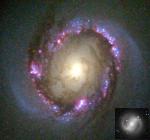 NGC 4314: A Nuclear Starburst Ring
11.12.1999
Is this old galaxy up to new tricks? The barred spiral galaxy NGC 4314 is billions of years old, but its appearance has changed markedly over just the past few millions of years. During that time, a nuclear ring of bright young stars has been evolving.
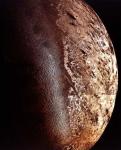 Triton: Neptune's Largest Moon
10.10.1999
One hundred and fifty three years ago, on October 10th, 1846, William Lassell was observing the newly discovered planet Neptune. He was attempting to confirm his observation, made just the previous week, that Neptune had a ring. But this time he discovered that Neptune had a satellite as well.
|
January February March April May June July August September October |
|||||||||||||||||||||||||||||||||||||||||||||||||