
|
You entered: Mercury
 APOD: 2025 September 1 Б Callisto: Dirty Battered Iceball
1.09.2025
Its surface is the most densely cratered in the Solar System -- but what's inside? Jupiter's moon Callisto is a battered ball of dirty ice that is larger than the planet Mercury.
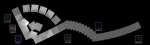 Solar System Portrait
13.02.2015
On another Valentine's Day 25 years ago, cruising four billion miles from the Sun, the Voyager 1 spacecraft looked back one last time to make this first ever Solar System family portrait. The complete portrait is a 60 frame mosaic made from a vantage point 32 degrees above the ecliptic plane.
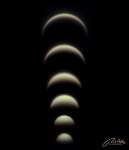 Phases of Venus
21.05.2020
Just as the Moon goes through phases, Venus' visible sunlit hemisphere waxes and wanes. This composite of backyard telescopic images illustrates the steady changes for Venus during its current stint as our evening star, as the inner planet grows larger but narrows to a thin crescent.
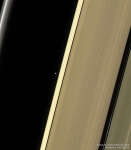 Earth and Moon through Saturns Rings
27.05.2020
What are those dots between Saturn's rings? Our Earth and Moon. Just over three years ago, because the Sun was temporarily blocked by the body of Saturn, the robotic Cassini spacecraft was able to look toward the inner Solar System.
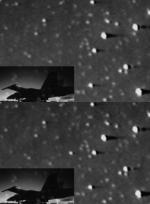 Astronomy From An F-18
28.01.2000
In an era of blossoming ground and space-based observatories, astronomers are also pushing the envelope with airborne instrumentation - successfully capturing an asteroid occultation from a high performance jet aircraft. This blinking animation represents...
 Saturn and Six Moons
6.07.2021
How many moons does Saturn have? So far 82 have been confirmed, the smallest being only a fraction of a kilometer across. Six of its largest satellites can be seen here in a composite...
 Planets, Endeavour at Dawn
21.05.2011
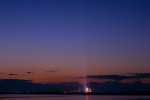
When dawn broke over Kennedy Space Center on Monday, May 16, the space shuttle orbiter Endeavour still stood on pad 39A. Its final launch, on mission STS-134 to the International Space Station, was only hours away.
 August Moons
21.08.2008
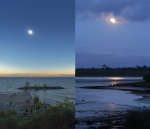
This August was eclipse season. The month's first New Moon and Full Moon were both seen in darkened skies during a solar and lunar eclipse. Blocking the Sun, the left panel...
 Planet Earth from SpaceShipOne
25.06.2004
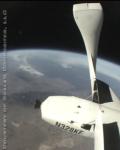
On June 21st, pilot Mike Melvill made a historic flight in the winged craft dubbed SpaceShipOne -- the first private manned mission to space. The spaceship reached an altitude of just over 62 miles (100 kilometers) on a suborbital trajectory, similar to the early spaceflights in NASA's Mercury Program. So, how was the view?
 Comet Leonards Tail Wag
10.01.2022
Why does Comet Leonard's tail wag? The featured time-lapse video shows the ion tail of Comet C/2021 A1 (Leonard) as it changed over ten days early last month. The video was taken by NASA's Solar Terrestrial Relations Observatory-Ahead (STEREO-A) spacecraft that co-orbits the Sun at roughly the same distance as the Earth.
|
January February March April May June July August September October |
|||||||||||||||||||||||||||||||||||||||||||||||||