
|
You entered: Mercury
 APOD: 2023 November 28 Б Ganymede from Juno
27.11.2023
What does the largest moon in the Solar System look like? Jupiter's moon Ganymede, larger than even Mercury and Pluto, has an icy surface speckled with bright young craters overlying a mixture of older, darker, more cratered terrain laced with grooves and ridges.
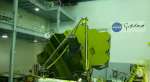 Webb Telescope Mirror Rises after Assembly
8.05.2016
Move over Hubble -- here comes the James Webb Space Telescope (JWST). JWST promises to be the new most powerful telescope in space. In the last month, the 18-segment gold-plated primary mirror for JWST was unveiled. In the featured time-lapse video taken last week, the 6.5-meter diameter mirror was raised to a vertical position.
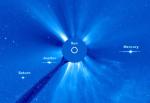 Planets In The Sun
5.05.2000
Today, all five naked-eye planets (Mercury, Venus, Mars, Jupiter, Saturn) plus the Moon and the Sun will at least approximately line-up. As viewed from planet Earth, they will be clustered within about 26 degrees, the closest alignment for all these celestial bodies since February 1962, when there was a solar eclipse!
 A Picturesque Venus Transit
3.06.2012
The rare transit of Venus across the face of the Sun in 2004 was one of the better-photographed events in sky history. Both scientific and artistic images flooded in from the areas that could see the transit: Europe and much of Asia, Africa, and North America.
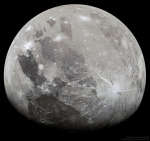 Ganymede from Juno
13.06.2021
What does the largest moon in the Solar System look like? Jupiter's moon Ganymede, larger than even Mercury and Pluto, has an icy surface speckled with bright young craters overlying a mixture of older, darker, more cratered terrain laced with grooves and ridges.
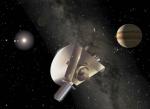 New Horizons at Jupiter
3.12.2003
Headed for the first close-up exploration of the Pluto-Charon system and the icy denizens of the Kuiper belt, NASA's New Horizons spacecraft is pictured here in an artist's vision of the robot probe outward bound.
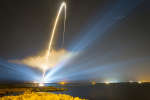 Parker vs Perseid
15.08.2018
The brief flash of a bright Perseid meteor streaks across the upper right in this composited series of exposures made early Sunday morning near the peak of the annual Perseid meteor shower.
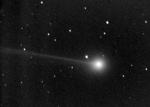 Comet Ikeya Zhang
20.02.2002
Comet Ikeya-Zhang is presently heading north in planet Earth's sky, framed by stars of the constellation Cetus. The comet was discovered as a faint, telescopic object near the western horizon on the evening...
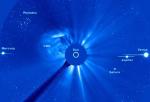 Pleiades, Planets, And Hot Plasma
24.05.2000
Bright stars of the Pleiades, four planets, and erupting solar plasma are all captured in this spectacular image from the space-based SOlar and Heliospheric Observatory (SOHO). In the foreground of the 15 degree wide field of view, a bubble of hot plasma, called a Coronal Mass Ejection (CME)
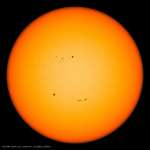 Live: Watching for Venus to Cross the Sun
5.06.2012
Today Venus moves in front of the Sun. One way to follow this rare event is to actively reload the above live image of the Sun during the right time interval and look for an unusual circular dark dot. The smaller sprawling dark areas are sunspots. The circular dot is the planet Venus.
|
January February March April May June July August September October |
|||||||||||||||||||||||||||||||||||||||||||||||||