
|
You entered: Mercury
 APOD: 2024 March 31 Б Total Solar Eclipse Below the Bottom of the World
31.03.2024
In late 2021 there was a total solar eclipse visible only at the end of the Earth. To capture the unusual phenomenon, airplanes took flight below the clouded seascape of Southern Ocean. The featured...
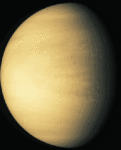 Venus: Earth's Cloudy Twin
23.09.1996
If Venus weren't so cloudy it would be more similar to Earth. This picture by the Galileo spacecraft shows just how cloudy Venus is. Venus is very similar to Earth in size and mass - and so is sometimes referred to as Earth's sister planet - but Venus has a quite different climate.
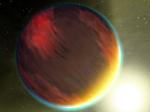 Atmospheres Detected on Two Extrasolar Planets
27.02.2007
Do extrasolar planets have water? In an attempt to find out, the orbiting Spitzer Space Telescope made detailed observations of the atmospheres of two planets that orbit stars other than our Sun. Unfortunately, water vapor was not detected in either exoplanet.
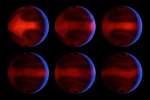 A Dangerous Summer on HD 80606b
4.02.2009
On the distant planet HD 80606b, summers might be dangerous. Hypothetic life forms floating in HD 080606b's atmosphere or lurking on one of its (presently hypothetical) moons might fear the 1,500 Kelvin summer heat, which is hot enough not only to melt lead but also nickel.
 APOD: 2024 September 25 Б Comet A3 Through an Australian Sunrise
25.09.2024
Comet Tsuchinshan-ATLAS is now visible in the early morning sky. Diving into the inner Solar System at an odd angle, this large dirty iceberg will pass its closest to the Sun -- between the orbits of Mercury and Venus -- in just two days.
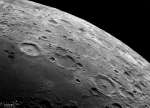 Lunar Craters Langrenus and Petavius
11.11.2019
The history of the Moon is partly written in its craters. Pictured here is a lunar panorama taken from Earth featuring the large craters Langrenus, toward the left, and Petavius, toward the right. The craters formed in separate impacts.
 Comet C/2025 F2 SWAN
18.04.2025
In late March, the comet now designated C/2025 F2 SWAN was found independently by citizen scientists Vladimir Bezugly, Michael Mattiazzo, and Rob Matson while examining publicly available image data from the Solar Wind ANisotropies (SWAN) camera on the sun-staring SOHO spacecraft.
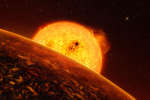 CoRoT Satellite Discovers Rocky Planet
23.09.2009
How similar is exoplanet CoRoT-7b to Earth? The newly discovered extra-solar planet is the closest physical match yet, with a mass about five Earths and a radius of about 1.7 Earths. Also, the home star to CoRoT-7b, although 500 light years distant, is very similar to our Sun.
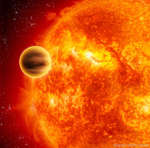 NGST 10b: Discovery of a Doomed Planet
26.02.2020
This hot jupiter is doomed. Hot jupiters are giant planets like Jupiter that orbit much closer to their parent stars than Mercury does to our Sun. But some hot jupiters are more extreme than others. NGTS-10b, illustrated generically, is the closest and fastest-orbiting giant planet yet discovered, circling its home star in only 18 hours.
 Encke and the Tadpoles
27.10.2023
History's second known periodic comet is Comet Encke (2P/Encke). As it swings through the inner Solar System, Encke's orbit takes it from an aphelion, its greatest distance from the Sun, inside the orbit of Jupiter to a perihelion just inside the orbit of Mercury.
|
January February March April May June July August September October |
|||||||||||||||||||||||||||||||||||||||||||||||||