
|
You entered: light
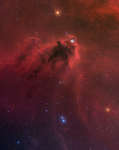 LDN 1622: Dark Nebula in Orion
21.02.2020
The silhouette of an intriguing dark nebula inhabits this cosmic scene. Lynds' Dark Nebula (LDN) 1622 appears against a faint background of glowing hydrogen gas only visible in long telescopic exposures of the region. In contrast, the brighter reflection nebula vdB 62 is more easily seen, just above and right of center.
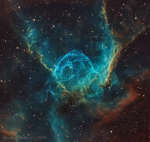 Thors Helmet
20.07.2021
Thor not only has his own day (Thursday), but a helmet in the heavens.б Popularly called Thor's Helmet, NGC 2359 is a hat-shaped cosmic cloud with wing-like appendages. Heroically sized even for a Norse god, Thor's Helmet is about 30 light-years across.
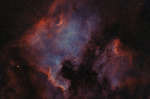 North America and the Pelican
8.09.2022
Fans of our fair planet might recognize the outlines of these cosmic clouds. On the left, bright emission outlined by dark, obscuring dust lanes seems to trace a continental shape, lending the popular name North America Nebula to the emission region cataloged as NGC 7000.
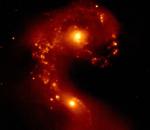 Antennae Galaxies in Near Infrared
11.04.2002
What happens when galaxies collide? One of the best studied examples of the jumble of star clusters, gas, and dust clouds produced by such a cosmic train wreck is the interacting galaxy pair NGC 4038 / NGC 4039, the Antennae Galaxies, only sixty million light-years away.
 Abell 1689 Warps Space
9.01.2003
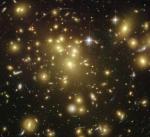
Two billion light-years away, galaxy cluster Abell 1689 is one of the most massive objects in the Universe. In this view from the Hubble Space Telescope's Advanced Camera for Surveys, Abell...
 X Ray Stars in the Orion Nebula
19.05.2005
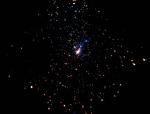
When our middle-aged Sun was just a few million years old it was thousands of times brighter in x-rays. In fact, it was likely similar to some of the stars found in this false-color x-ray composite of the Orion Nebula region from the Chandra Observatory.
 NGC 1999: South of Orion
30.01.2006
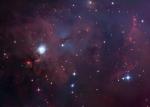
South of the large star-forming region known as the Orion Nebula, lies bright blue reflection nebula NGC 1999. The nebula is marked with a dark inverted T-shape at the lower left in a broad cosmic vista that spans over 10 light-years.
 Central Cygnus
4.01.2007
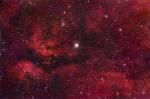
Supergiant star Gamma Cygni lies at the center of the Northern Cross, famous asterism in the constellation Cygnus the Swan. Known by the proper name Sadr, the bright star also lies at the center...
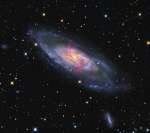 Messier 106
19.03.2011
Close to the Great Bear (Ursa Major) and surrounded by the stars of the Hunting Dogs (Canes Venatici), this celestial wonder was discovered in 1781 by the metric French astronomer Pierre Mechain. Later, it was added to the catalog of his friend and colleague Charles Messier as M106.
 In the Center of the Omega Nebula
6.05.2012
In the depths of the dark clouds of dust and molecular gas known as the Omega Nebula, stars continue to form. The above image from the Hubble Space Telescope's Advanced Camera for Surveys shows exquisite detail in the famous star-forming region.
|
January February March April May June July August September October |
|||||||||||||||||||||||||||||||||||||||||||||||||