
|
You entered: light
 Asteroids Near Earth
1.10.2011
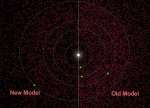
Though the sizes are not to scale, the Sun and planets of the inner solar system are shown in this illustration, where each red dot represents an asteroid. New results from NEOWISE, the infrared...
 Sharpless 308: Star Bubble
24.12.2013
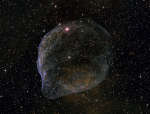
Blown by fast winds from a hot, massive star, this cosmic bubble is huge. Cataloged as Sharpless 2-308 it lies some 5,200 light-years away toward the constellation of the Big Dog (Canis Major) and covers slightly more of the sky than a Full Moon.
 The Tulip and Cygnus X 1
16.02.2017
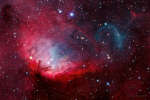
Framing a bright emission region, this telescopic view looks out along the plane of our Milky Way Galaxy toward the nebula rich constellation Cygnus the Swan. Popularly called the Tulip Nebula, the reddish glowing cloud of interstellar gas and dust is also found in the 1959 catalog by astronomer Stewart Sharpless as Sh2-101.
 Lunar LOVE
3.11.2018
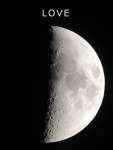
A more creative search by a group of amateur astronomers in the Ehime Prefecture of Shikoku Island, Japan has found lunar L-O-V-E. Their secret was an examination of this sharp image of the First Quarter Moon.
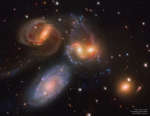 Stephan's Quintet from Hubble
3.06.2019
When did these big galaxies first begin to dance? Really only four of the five of Stephan's Quintet are locked in a cosmic tango of repeated close encounters taking place some 300 million light-years away.
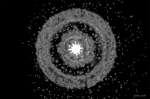 X Ray Rings Around a Gamma Ray Burst
17.10.2022
Why would x-ray rings appear around a gamma-ray burst? The surprising answer has little to do with the explosion itself but rather with light reflected off areas of dust-laden gas in our own Milky Way Galaxy.
 APOD: 2023 July 9 Б Doomed Star Eta Carinae
9.07.2023
Eta Carinae may be about to explode. But no one knows when - it may be next year, it may be one million years from now. Eta Carinae's mass - about 100 times greater than our Sun - makes it an excellent candidate for a full blown supernova.
 Simulation: Two Black Holes Merge
10.05.2024
Relax and watch two black holes merge. Inspired by the first direct detection of gravitational waves in 2015, this simulation plays in slow motion but would take about one third of a second if run in real time. Set on a cosmic stage, the black holes are posed in front of stars, gas, and dust.
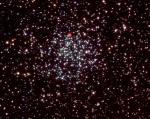 M46 And NGC 2438: Young And Old
5.03.1999
Galactic or open star clusters are relatively young. These swarms of bright stars are born near the plane of the Milky Way, but their numbers steadily dwindle as cluster members are strewn through the Galaxy by gravitational interactions.
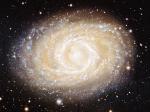 Barred Spiral Galaxy M95
14.03.2007
Why do some spiral galaxies have a ring around the center? First and foremost, M95 is one of the closer examples of a big and beautiful barred spiral galaxy. Visible in the above recent...
|
January February March April May June July August September October |
|||||||||||||||||||||||||||||||||||||||||||||||||